The Brutal State of B2B SaaS Onboarding
Most SaaS onboarding is broken. Not in an obvious, embarrassing way — in a slow, expensive, invisible way. The average B2B SaaS company still runs onboarding on a cocktail of demo calls, email sequences, help docs, and hope. It takes days to weeks before a new user reaches their first moment of genuine value. By then, half of them have already moved on.
The data is damning. 75% of users abandon a product they can't figure out within a week. One in two quits if they can't get value in three minutes. Every extra minute of friction in a trial flow drops trial-to-paid conversion by roughly 3% (OpenView). And yet the median onboarding checklist completion rate across SaaS is just 10.1% — meaning 9 in 10 users never finish the flow you built for them.
The cost of slow onboarding isn't just churn — it's a cascading failure across your entire GTM. Slow onboarding means slower activation, which means fewer expansion signals, which means your PLS motion has no pipeline to work from. Over 20% of voluntary churn traces directly to poor onboarding (Recurly, 2025). That's not a product problem — it's a revenue problem.
The Conversion Science: Why Speed Is the Variable
The relationship between time-to-value and conversion is one of the most well-documented causal chains in SaaS growth. The faster a user reaches their "aha moment," the higher the probability they convert, retain, and expand.
Activation is the moment a user first experiences the core value of your product. It's not signup. It's not completing a tour. It's the instant they feel the product working for them.
| Metric | What It Measures | Industry Avg | Elite PLG Target |
|---|---|---|---|
| Activation Rate | % reaching aha moment that predicts retention | ~15–20% | 25–40%+ |
| Time-to-Value (TTV) | Minutes from signup to first meaningful success | Days–weeks | <5 minutes |
| D7 Retention | % of users active 7 days after signup | ~10-15% | 35%+ |
| D30 Retention | % of users active 30 days after signup | ~3-5% | 15-20%+ |
| Onboarding Completion | % finishing structured flow | 10.1% median | 40%+ |
| Free-to-Paid Conv. | % of free users who upgrade | ~9% | 15–25% |
Benchmark Your Product
Want to see how your activation, D7, and D30 metrics look inside a unified revenue engine?
Access ThriveStack's live PLG ScorecardAI-Powered Onboarding: The New Paradigm
The era of static tooltip tours is over. AI is replacing this with onboarding that watches what users do, adapts in real time, pre-loads value using the customer's own data, and delivers a relevant path to the aha moment at machine speed.
| Traditional Onboarding | AI-Powered Onboarding |
|---|---|
| Static tours and checklists | Adaptive, behavior-triggered journeys |
| Generic demo content | Customer's own data, live on day one |
| Linear flows for all users | Segmented paths by ICP, role, intent signal |
| Feature-first, then value | Value-first, features discovered in context |
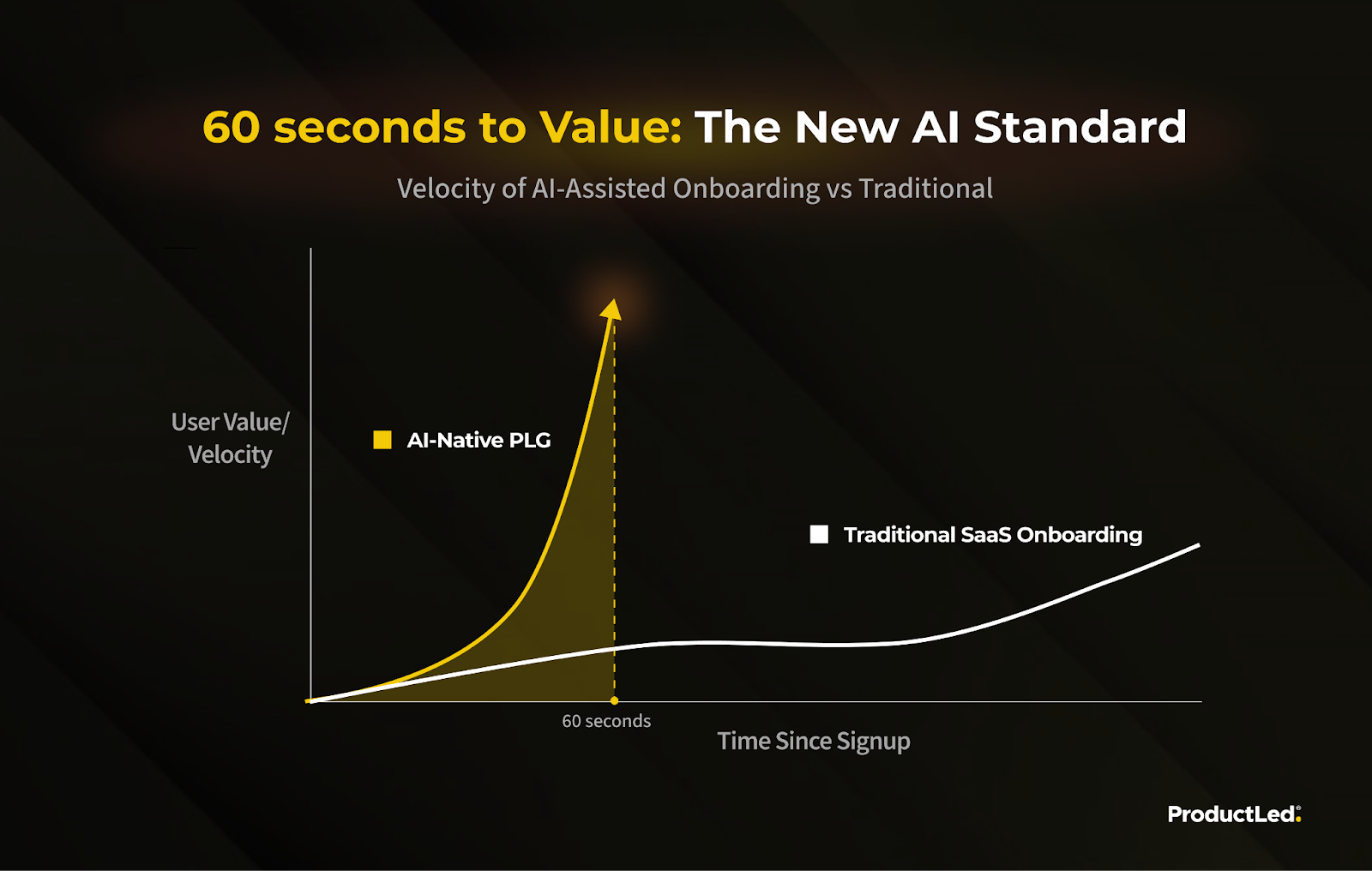
60 Seconds to Value: The New AI Standard
Wes Bush and the team at ProductLed found that the best AI native products deliver value under 60 seconds.
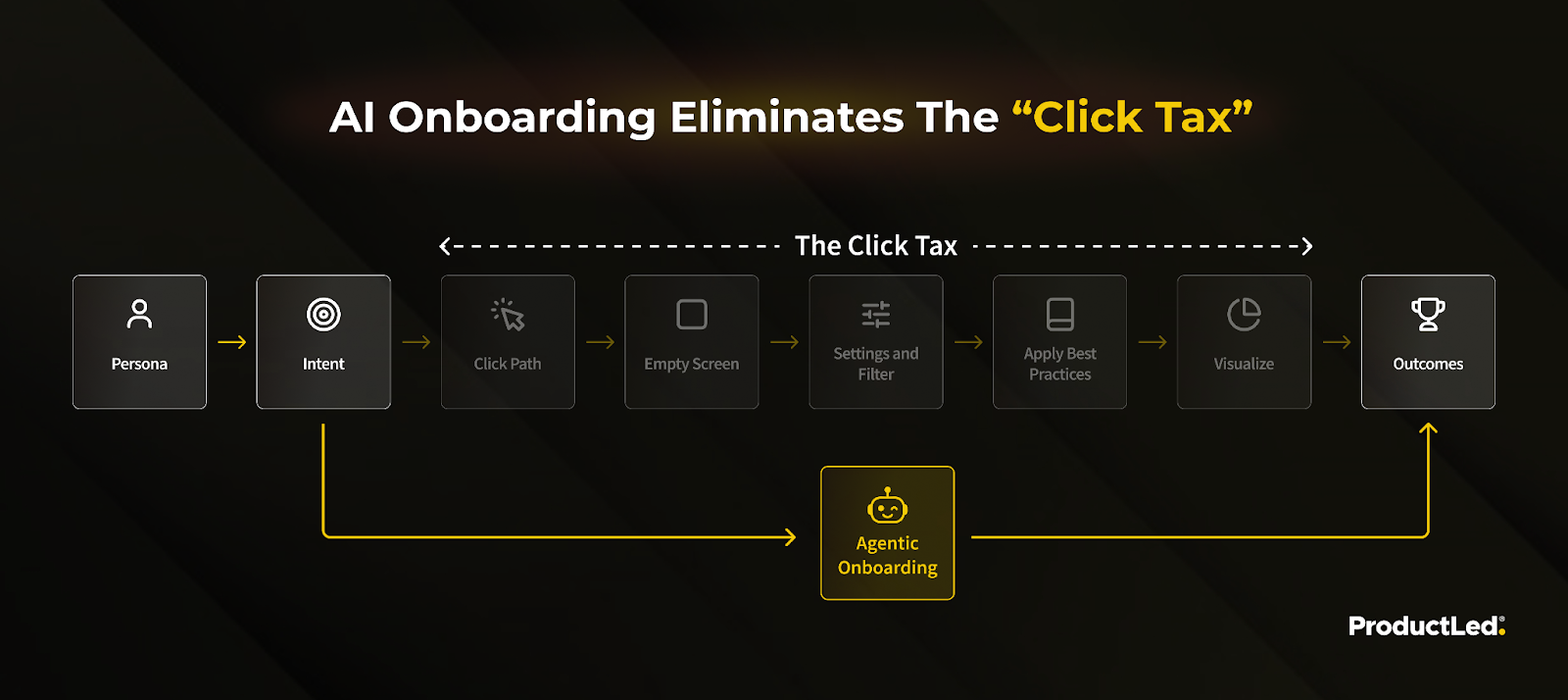
Eliminating the Click Tax
Mickey Alon defines the "Click Tax" as all in-app actions that do not directly move the user toward their desired outcome. Today, AI can absorb that cost entirely.
Real Market Case Studies: What the Winners Did
Notion
Notion solved the "blank page problem" by making template installation the entire onboarding experience. Converts learn-by-tutorial to learn-by-customizing.Source
Airtable
Replaced tutorials with an interactive wizard mapping a user's job-to-be-done. Also tracked "Week-4 multi-user active" as the true north star.Source
Intercom Fin
Charges $0.99 per resolved conversation. Built a self-serve PoC flow forcing admins to validate resolution quality before public deployment.Source
HubSpot Breeze
Breeze AI layer handles onboarding at scale. Scale onboarding without adding headcount, contributing to 65% more productive new hires.Source
Zapier Canvas
Uses AI to instantly draft complex multi-step automations purely from natural language prompts, bypassing the learning curve entirely.Source
Canva Magic
Magic Design scans user-uploaded media to instantly generate customized, branded templates across multiple formats directly on sign-up.Source
ThriveStack's Own Product Activation Journey
The Transformation
From demo-heavy and manual to
self-serve and AI-guided
We don't just build revenue intelligence for B2B SaaS — we ran this exact experiment on ourselves. Here's how ThriveStack went from a 3-week manual onboarding process to activating new accounts in under 15 minutes, and what we learned building the platform that made it possible.
The Challenge: We Were Eating Our Own Bottleneck
Like most B2B SaaS companies targeting CROs and GTM leaders at Series B/C, ThriveStack started with a high-touch, demo-led GTM motion. A prospect would request a demo. We'd schedule a call. Walk them through the platform. Come back for a technical setup session. Coordinate integrations. Run a discovery call to map their signals. Onboard their data. Then wait for them to "see value." The whole cycle took 3+ weeks — minimum.
The Setup Burden: Our prospects did not want to pay the click tax
We previously operated with a heavy, manual onboarding process across multiple fragmented teams. It looked like this:
Before (Manual setup by different teams): 3+ Weeks
| Setup Step | Time Spent |
|---|---|
| Setup Marketing intelligence | 5 mins |
| Setup Product IntelligenceInclude saas events & growth telemetry | 1-10 days |
| Setup Revenue IntelligenceSync their Billing data (Stripe/Chargebee etc) with ThriveStack | 15 mins |
| Sync growth SignalsTo and From CRM | 10 mins |
| Setup Customer Health Scores | 10 mins |
| Total Manual Setup Time | 11-20+ Days |
The Solution: LLM Based Install
We rebuilt ThriveStack's onboarding using the same AI-native principles we preach. Our prospects wanted to bypass the click-tax, so we gave them what we call the Setup with AI flow.
After (LLM based install): <15 Minutes
The entire 5-step process above is now handled concurrently by an LLM-powered agent. Time-to-value dropped from over 3 weeks to under 15 minutes, with clean activation signals available on Day 1.
Unify Revenue data:
Install with your favorite AI coding assistant
Traditional tools take 3-4 weeks for each of the following,
Lets do this all in next 10 mins.


Install Marketing Intelligence for your Website, Lead Magnets, Vibe Apps
Track pageviews, referrers, and conversion events with zero configuration.
Get an API Key
Sign up and grab your unique API key for Marketing Intelligence.
Prompt to Install
Verify Results
What We Learned
When we instrumented our own onboarding, we found drop-offs happened 4 steps earlier than assumed. You need unified signals from moment one — not just post-activation. The companies that win treat the first 15 minutes as their highest-density product surface.
The Activation Growth Framework
Activation doesn't just affect the current quarter — it compounds. Improving activation raises conversion, NRR, and LTV simultaneously.
The question isn't whether improving activation compounds — it's how fast and how much for your specific model. That depends on your current activation rate, your trial-to-paid conversion baseline, your ACV, and your expansion rate. These variables interact non-linearly, which is why the math surprises founders every time they model it properly.
Model your Activation Revenue Impact
Input your current metrics and see exactly how improving activation affects ARR, NRR, and payback period — specific to your SaaS model.
Model Your Activation RevenueThe Playbook: 10 Things to Do Now
The gap between knowing activation matters and actually moving it is where most SaaS teams get stuck. Here's the concrete sequence that compounds fastest.
Define one activation metric that predicts week-8 retention.
Not "completed onboarding." Not "logged in twice." The specific action that correlates to a retained customer in your product.
Instrument your first session before fixing anything else.
You don't know where users are dropping off. You're guessing. Event-level product analytics from minute one changes your iteration speed.
Eliminate every step that doesn't directly lead to the aha moment.
Audit your current flow: how many steps are for your internal benefit vs. the user's benefit? Cut relentlessly.
Pre-load value using the customer's own data.
The fastest path to the aha moment is showing the product working on their problem, not a demo scenario.
Build a reverse trial if you're freemium.
Give all users access to your top plan for 14 days, let them experience the ceiling, then decide.
Add an AI copilot to your setup flow.
An LLM-powered in-product assistant that answers configuration questions reduces drop-off substantially.
Track account-level activation, not just user-level.
In B2B, a single activated power user who never brings in teammates is a churn risk.
Unify your onboarding signal with your revenue data.
Activation data that lives in a separate product analytics tool from your billing and CRM is incomplete.
Measure TTV in minutes, not days.
Elite PLG companies target under 5 minutes. That's your competitive moat or your exposure.
Don't hire a sales team before your PLG pipeline is ready.
Fix activation first. Sales second.