
Four numbers frame this guide. Perplexity cites 19.2 sources per answer and Claude cites 3.6, so engines differ in how much they cite (section 4). Gemini names the brand in 83.7% of appearances but links it in 21.4%, so being named matters (section 4). Only 27% of brands overlap between Gemini and AI Overviews, so each surface needs its own plan (section 3). And Gemini named ThriveStack in 12.5% of our own probe answers, which is the baseline to beat (section 9).
Good SEO is good GEO.

Search Engine Land, reporting his WordCamp US keynote, Aug 28, 2025
What did our AI search visibility test show for Gemini and ChatGPT?
Across 10 buyer prompts, Gemini searched every time and ChatGPT searched on 7. Gemini cited 9.2 pages per answer to ChatGPT’s 6.6, and about three in four of Gemini’s pages were roundup or comparison posts. Gemini also repeated itself more: its most-named tool appeared in 9 of 10 answers.
ThriveStack citedby ran 10 prompts a buyer might type, once each on both engines, on Oct 24, 2026. They covered tracking, share of voice, GEO and AEO software, and agency reporting. We used the DataForSEO LLM API with search on. API answers can differ from the apps, and one run each is a small sample, so read this as a first look at how the engines differ.
Gemini ran 2 or 3 searches each time. It cited 61 different sites in 92 citations, so it leaned on roundups and agreed with itself. Its three most-named tools made up 49% of all tool mentions. A place in those roundups is the fastest route onto these prompts.
ChatGPT skipped search on 3 prompts and answered from general knowledge. When it searched, it ran 3 or 4 queries and cited 40 different sites in 46 citations. Its answers spread out more. Its three most-named tools made up 27% of mentions, and its top tool appeared in 5 of 10 answers.
The two lists also differ. Counted against 33 known tools, 30 were named by at least one engine and only 13 by both. Section 2 explains how Gemini picks sources, and the 90 day plan in section 9 tests both engines with your own prompts.
How does Gemini Grounding with Google Search choose sources?
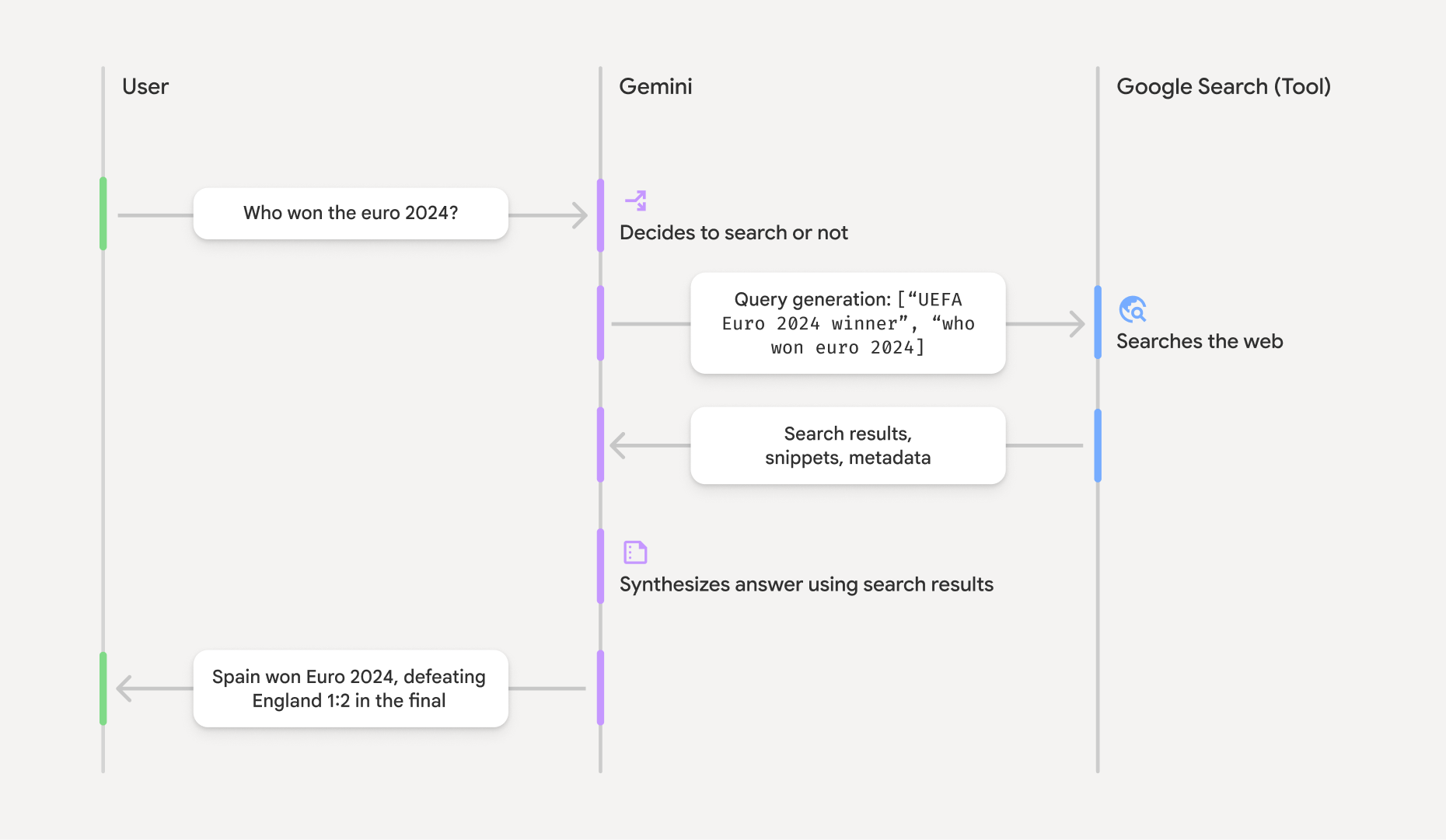
Gemini decides if a question needs fresh facts. If it does, it writes search queries, runs them on Google Search, reads the results and cites the pages it used. Google documents those steps in Grounding with Google Search. It does not say how it ranks the pages it picks, so treat any claim about that as a guess.
The figure shows four steps. Steps 1, 2 and 4 come from Google’s developer docs. Each link ties one span of the answer to one URL. Step 3 is the gap, which is why this guide marks what is confirmed and what is inferred.
The live test in section 1 shows the difference. With search on, Gemini cited pages on all 10 prompts. In one run with search off, it cited none.
What is Google AI Overviews SEO, and how do AI Mode and the Gemini app differ?
Google AI Overviews, Google AI Mode and the Gemini app are three surfaces that cite different sources. Google says AI Overviews and AI Mode may use different models. Profound found Gemini shares only 27% to 29% of its brands with the other two. Plan for each surface on its own.
The figure compares the three. AI Mode cites the most per run, at 15.2. The Gemini app cites the fewest, at 6.6, and leans toward editorial and reference sites. Profound is a vendor, its data covers May 2026, and it does not say if “Gemini” means the app.
The entry rules are the same for the two Search features. Google says a page must be indexed and eligible to show a snippet, with no additional requirements. Ahrefs found that only 37.9% of AI Overview citations now come from the top 10 results, down from about 76% in an earlier study. Ranking well helps less than it did.
Gemini vs ChatGPT: which one names brands and which one links them?
Gemini names brands and ChatGPT links them. Semrush found Gemini named the brand in 83.7% of appearances but linked it in 21.4%. ChatGPT linked the brand in 87% and named it in 20.7%. On Gemini, being said in the answer matters. On ChatGPT, the link matters.
The figure shows the Semrush counts across 3,981 domain appearances and 115 prompts. 61.7% were ghost citations, which means linked with no brand name. Semrush sells the tools behind this data, so read it as one view.
Orbit Media counted sources per answer across 72 prompts, 3 brands and 13,184 citations. The second figure shows the result. Perplexity cited 19.2, Gemini 8.1, ChatGPT 4.5 and Claude 3.6. The four engines agreed on only 1.7% of cited domains. Orbit Media ran the engines through APIs and calls its own result directional.
Our test on Oct 24 fits the pattern. Across 10 buyer prompts, Gemini cited 9.2 pages per answer and ChatGPT cited 6.6. Gemini also repeated its top tools more often than ChatGPT did.
How to get cited by Gemini, and what changes for ChatGPT and Claude?
Each engine has its own crawler. Allow OAI-SearchBot so ChatGPT can show your pages in search, and Claude-SearchBot for Claude. Gemini uses Googlebot. OpenAI says GPTBot is for training only. Only 1.7% of cited domains matched across four engines in one study, so one plan does not fit all.
The figure lists each vendor’s search crawler and how to control it. ChatGPT-User and Claude-User fetch pages when a person asks. OpenAI says ChatGPT-User does not decide search placement.
Treat the search source row with care. Profound says ChatGPT search sits on Bing, but only 26.7% of its results matched Bing’s top results. Profound inferred that Claude uses Brave Search from three queries. Neither vendor confirms it. Both are hints, so test before you rely on them.
Pick the AI engines to monitor for your brand
Each engine cites differently, so track each one. ThriveStack citedby lets you choose the engines to monitor, up to your plan limit: ChatGPT, Google AI Overview, Google Gemini, Google AI Mode, Perplexity, Microsoft Copilot and more. You then see where each one names or links you.
Choose your engines →
Does entity SEO help Gemini cite your brand?
Entity SEO may help, but no controlled test shows it. An entity is a clearly defined thing, such as your company, with one name and one set of facts across the web. Google says AI features need no special markup. Treat entity work as a low-cost bet, and measure it yourself.
Many teams ask about schema markup for AI search. Searches for it grew from 10 to 70 a month in a year. The best test so far is from Ahrefs. It followed 1,885 pages that added JSON-LD and compared them with about 4,000 pages that did not. AI Overview citations fell 4.6% against the controls. AI Mode and ChatGPT showed no change you could tell from zero.
Read that result with its limits. Every page was already heavily cited, the window was 30 days, and the Gemini app was not measured. So the test does not show that schema never helps. It shows that adding it did not move citations for these pages.
Organization schema is still worth adding for a different reason. Google’s documentation says it helps Google tell your organization apart from others. Pair it with one name, linked profiles and outside mentions. Gemini names brands far more often than it links them, so a clear brand may be named more often. That last step is our inference.
| # | Claim | What the evidence says | Rating |
|---|---|---|---|
| 1 | Google needs special markup for AI features | Google says there are no additional requirements | Confirmed by Google |
| 2 | Adding JSON-LD lifts AI citations | Ahrefs matched test of 1,885 pages: AI Overviews fell 4.6%, AI Mode and ChatGPT stayed flat | Tested, no lift. Gemini app not measured |
| 3 | Organization markup clears up who you are | Google’s documentation says it helps Google tell organizations apart | Documented. Effect on citations untested |
| 4 | Clear entities help Gemini name you | Inference from Gemini’s habit of naming brands (Semrush) | Untested |
What are the five moves for Gemini SEO?
Gemini SEO comes down to five moves, ranked by evidence. Get indexed and snippet-eligible. Answer the question first in plain text. Get mentioned on sites Gemini reads. Make your entity clear. Re-test every month. Google confirms the first. The last four rest on guidance, studies and inference.
Google’s own team says the same, as the quote near the top of this page shows. The basics have not changed, and a page that works for search works for AI answers. Mentions come next. Seer Interactive found Reddit (44%) and Wikipedia (33%) held steady in Gemini answers while YouTube fell from 18% to 3%. In our 10-prompt test, about three in four Gemini citations were roundup or comparison posts. Being listed there is the fastest route onto those prompts.
Gemini SEO Implementation Checklist: What to Fix First
Ranking in Google Gemini means ensuring your brand is crawl-accessible, unambiguous in Google Knowledge Graph, and verified across authoritative third-party sources. Use this 16-point operational checklist to audit your technical grounding, entity definition, query fan-out content, and prompt-panel performance.
Verify Google-Extended is Not Disallowed in robots.txt
Ensure robots.txt does not disallow the Google-Extended product token, which directly controls Gemini training and live search grounding access.
Audit Snippet Eligibility in Google Search Console
Confirm all high-intent money pages are indexed and free from nosnippet or restrictive max-snippet directives.
Verify Complete DOM Rendering with Evergreen Chromium
Ensure critical pricing, specifications, and comparison matrices are rendered in clean HTML accessible to Google headless browser.
Define One Canonical Entity Sentence
Formulate a single, crystal-clear boilerplate definition of your brand and ICP that Gemini can ingest without ambiguity.
Synchronize Entity Phrasing Across Third-Party Profiles
Propagate your exact entity sentence across LinkedIn, Crunchbase, G2, Capterra, and press boilerplate.
Deploy Organization Schema with sameAs Authority Arrays
Connect your digital footprint to Google Knowledge Graph using structured Organization and SoftwareApplication JSON-LD.
Claim and Reconcile Google Knowledge Panel
Claim your official Google Knowledge Panel to correct conflicting category, founder, or headquarters data.
Publish Transparent Pricing with Exact Tiers and Feature Allowances
When users ask broad buyer questions, Gemini fans out to "[brand] pricing" searches. Pages with real numbers get cited.
Build Objective Side-by-Side Comparison Hubs
Create dedicated "[Brand] vs [Competitor]" and "[Competitor] Alternatives" pages formatted with structured evaluation matrices.
Apply Answer-First Formatting to All Key Sections
Open each H2 and H3 with a 1-2 sentence direct factual answer before expanding into analysis and details.
Create Modular Integration and Industry Landing Pages
Target Gemini long-tail query fan-outs for "[brand] + [integration]" and "[category] for [industry]".
Claim and Optimize Tier-One Review Directory Profiles
Maintain complete, active profiles on G2, Capterra, TrustRadius, and Gartner Peer Insights where Google grounds entity trust.
Secure Inclusion in Page-One Organic Category Roundups
Identify the top 5 ranking "Best [Category] Tools" roundups on Google Search and ensure your brand is represented.
Cultivate Genuine Presence in Community and Developer Discussions
Engage authentically in Reddit, GitHub discussions, and niche forums that Google indexes heavily for unvarnished sentiment.
Keep External Pricing and Product Facts Synchronized
Whenever pricing, tiers, or features change, update third-party listings immediately to eliminate conflicting data.
Curate a 20-30 Query Buyer Prompt Panel
Construct a representative evaluation set divided across Category, Comparison, and Problem-solving queries.
Conduct Monthly Incognito Audits and Track Referral Traffic
Run your prompt panel in fresh, signed-out Gemini sessions and track gemini.google.com referral sessions.
How to rank in Google AI Mode, and is the demand real?
Rank in Google AI Mode the way you win in Search: be indexed, snippet-eligible and useful. Google lists no extra requirements. Demand is real. Monthly searches for Google AI Mode rose from 90,500 in October 2025 to 1.5 million in September 2026. Searches for AI Overviews rose from 74,000 to 246,000. Gemini is the biggest of all: “google gemini” went from 5 million to 9.1 million.
The figure indexes all three to October 2025, so growth compares fairly. AI Mode grew fastest. Gemini started from a far bigger base. The plain phrase “ai mode” is larger still, at 2.7 million, but most of those people want to open the product. We do not target it.
Expect the sources to move. Evertune, a vendor, found unique URLs cited fell 33% on Gemini and 59% on AI Mode between late April and early June 2026, while total citations did not fall. The cause is unclear. Fewer sources can mean each win counts for more, so keep your pages current.
How do you measure AI search visibility on Gemini?
Measure AI search visibility per engine, with the same prompts, run several times, every month. Count two things: how often the answer names you and how often it links you. ThriveStack citedby tracks both. In our probe of 32 prompts, Gemini named ThriveStack in 4 answers, ChatGPT in 3 and Google AI Overviews in 1.
The figure turns that into a 90 day plan. Run each prompt 7 times per engine, because one run can mislead. Seer Interactive saw the share of Gemini answers with citations drop from 99% to 76% between February and March 2026. Seer is an agency, and its author says the sample does not represent all of Gemini.
Our own numbers are small and come from one brand, so read them as a baseline. Three prompts name ThriveStack, and they produced 7 of the 9 cited answers. On the other 29 prompts, thrivestack.ai was cited in 2 of 87 answers. That is the gap this plan is built to close.
The table counts every source the engine retrieved, including ones never linked in the answer. Do not set it beside the Orbit Media figures. For the prompt side, see our prompt panel guide, and our AEO guide for what each change is meant to move.
See which of your pages AI can actually cite
Connect Google Search Console to ThriveStack citedby and the whole pipeline shows up in one view: every sitemap page, Google crawled vs indexed, the pages AI bots fetched in your server logs, and the citations they earned.
See the sample pipeline →Sample data, no signup. Connect Search Console when you are ready.| # | Engine | Brand named | Domain in sources | Avg sources retrieved |
|---|---|---|---|---|
| 1 | Gemini | 4 of 32 (12.5%) | 4 of 32 | 7.5 |
| 2 | ChatGPT | 3 of 32 (9.4%) | 4 of 32 | 22.4 |
| 3 | Google AI Overviews | 1 of 32 (3.1%) | 1 of 32 | 4.7, and none for 13 prompts |
See where Gemini cites you, and where it skips you
ThriveStack citedby runs your prompts on Gemini, ChatGPT and Google AI Overviews and shows when you are named or linked.
Start free trial →Getting cited by Gemini: FAQ
Get your pages indexed and eligible for snippets, answer each question first in plain text, and get mentioned on the roundup and reference sites Gemini reads. Then re-test every month, because Gemini’s sources change often.
Google says AI features have no additional requirements and need no special markup or AI text files. An Ahrefs test of 1,885 pages found no citation lift from adding JSON-LD in AI Overviews, AI Mode or ChatGPT. It did not measure the Gemini app.
No. They are three surfaces. Google says AI Overviews and AI Mode may use different models, and Profound found Gemini shares only 27% to 29% of its brands with the other two.
Gemini names brands more than it links them. ChatGPT links more than it names. Semrush found Gemini named the brand in 83.7% of appearances and linked it in 21.4%. ChatGPT linked it in 87% and named it in 20.7%.
Often. Seer Interactive saw the share of Gemini answers with citations fall from 99% to 76% between February and March 2026. Evertune, a vendor, saw unique cited URLs fall 33% on Gemini. Both are samples, so track your own prompts.
It may, but no controlled test shows it. Use one brand name, link your profiles, add Organization markup and earn outside mentions. Measure the result with the same prompts before and after.
Sources & References
- Google AI for Developers, Grounding with Google Search.
- Google Search Central, AI features and your website.
- Google Search Central, Organization structured data.
- Orbit Media, LLM Citation Study, Sep 2, 2026.
- Semrush, Ghost Citations study, Jun 9, 2026.
- Profound, Gemini vs AI Overviews vs AI Mode, Jul 14, 2026.
- Profound, How Claude web search works.
- Seer Interactive, Gemini citations decreased 23 points, Apr 13, 2026.
- Ahrefs, AI Overview citations and the top 10, Mar 2, 2026.
- Ahrefs, Does adding schema increase AI citations?, May 11, 2026.
- Adapt, Google slashes AI citation sources by 59%, Jul 3, 2026 (Evertune data).
- OpenAI, Crawlers and bots.
- Anthropic, Does Anthropic crawl data from the web.
- Search Engine Land, Google’s Danny Sullivan: Good SEO is good GEO (WordCamp US keynote, Aug 28).
- ThriveStack citedby probe of thrivestack.ai, 32 prompts on Gemini, ChatGPT and Google AI Overviews, run Oct 20, 2026.
- DataForSEO, LLM API live test (Oct 24, 2026, 10 prompts, one run each per engine) and Google Ads keyword data for the US, monthly searches Oct 2025 to Sep 2026.
Related Empirical Studies
How to Build an AI Prompt Panel
Step-by-step framework to test multi-model answer engines with consistent, unbiased prompt panels.
PlaybookAEO Guide: Answer Engine Optimization
Complete tactical guide to optimizing React, SPA, and modern web architectures for AI crawlers.
Automation PlaybookSEO Automation for AI Search
How to build automated AEO and GEO content campaigns from citation gaps to proof.