ThriveStack is excited to introduce the Self-Serve (PLG) Business Growth Scorecard -
a unified, cross-department growth dashboard that helps Product-Led SaaS teams instantly understand the health of their self-serve business. With a single view across awareness, acquisition, activation, conversion, retention, and expansion, teams can finally correlate metrics, assign ownership, and review their entire growth model holistically.
Inspirations Behind This Launch
We stand on the shoulders of giants.
This Scorecard is shaped by some of the most influential voices in the PLG and Growth ecosystem:
- Wes Bush & Ramli John (ProductLed) — for championing Activation as a foundational North Star metric for PLG.
- Andrew Capland (Delivering Value) — for advancing the concept of a Growth Operating System that aligns teams around repeatable, cross-functional growth.
- Nick Mehta (Gainsight) — for leading the industry in proving that Retention is the ultimate growth multiplier, especially past $5M ARR.
- Kyle Poyar — for emphasizing team and department ownership as the backbone of efficient growth execution.
- Jacco van der Kooij, Dave Boyce, and Dan Patterson (Winning by Design) — for pioneering and popularizing the Bow‑Tie Revenue Architecture, which forms the backbone of how modern SaaS companies measure acquisition, retention, and expansion.
These principles heavily influenced how we designed the PLG Scorecard to unify visibility, ownership, and accountability across your entire self-serve funnel.
“Before the PLG Scorecard, we were flying blind. Now every team sees where growth stalls, who owns what, and how performance is trending. We increased activation by 32% in just 45 days.
The High Cost of Invisible Growth Gaps
In product-led businesses, visibility across the funnel is often fragmented across marketing, product, revenue, and data teams. As a result:
- Growth leaks go undetected
Example: Teams see a spike in website traffic, but no meaningful uplift in Signups or Demo Requests. - Department alignment breaks down
Example: Marketing successfully drives traffic, but visitors don’t convert — revealing friction in targeting, messaging, or the signup experience. - Activation doesn’t translate into Conversion
Example: Users activate core features but fail to convert to paid plans, indicating gaps in value realization or packaging. - Engagement does not turn into Retention
Example: Users return frequently early on, but drop off after week two — showing missing habit loops or weak long-term value. - Retention fails to drive Expansion
Example: Accounts remain active but rarely expand because expansion triggers go unnoticed and champions aren’t identified. - Decision-making slows
Example: Teams lack shared data, delaying experiments and reducing growth velocity. - Revenue becomes unpredictable
Example: Leaders cannot forecast accurately without clarity on where funnel performance breaks.
Scope of the Problem
PLG teams are operating with massive blind spots that stall growth and distort revenue predictability.
Product Feature Highlights
Core Feature Set
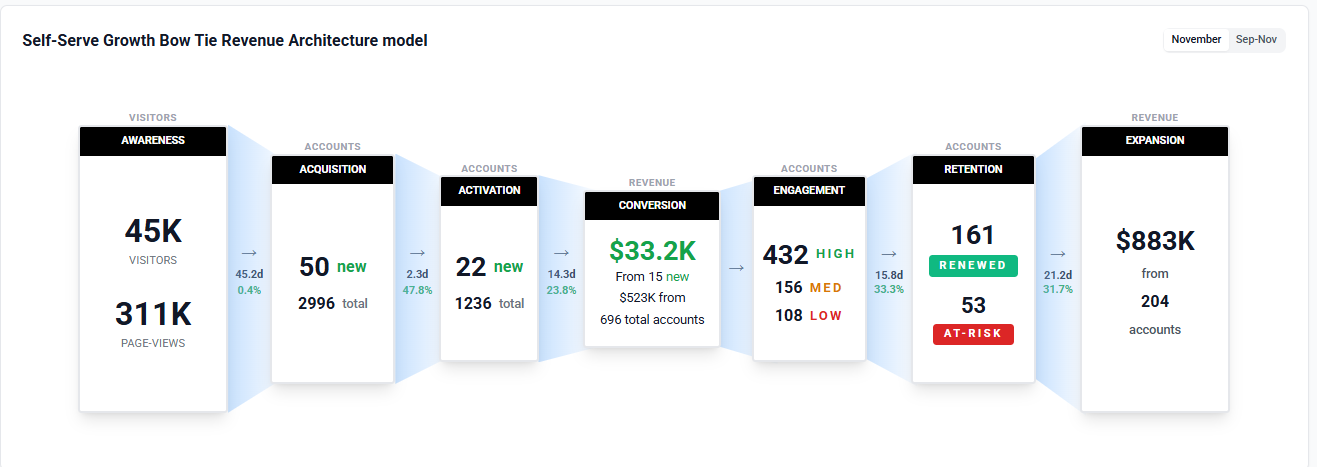
1. Full Journey Visibility — Understand every stage of your bow-tie PLG model: Awareness → Acquisition → Activation → Conversion → Engagement → Retention → Expansion.
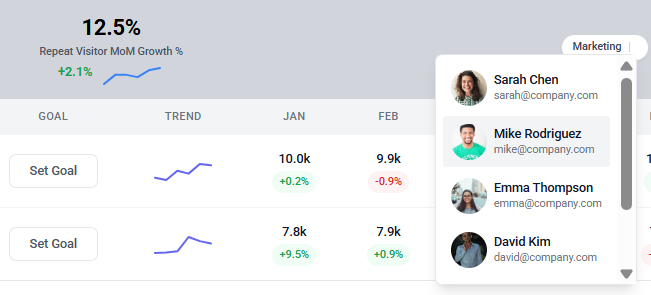
2. Department Ownership Assignments — Clearly assign each metric to Marketing, Product, Sales, RevOps, or CS.
3. Trend Analysis & Correlation — Spot patterns, compare periods, and see how one stage impacts another.
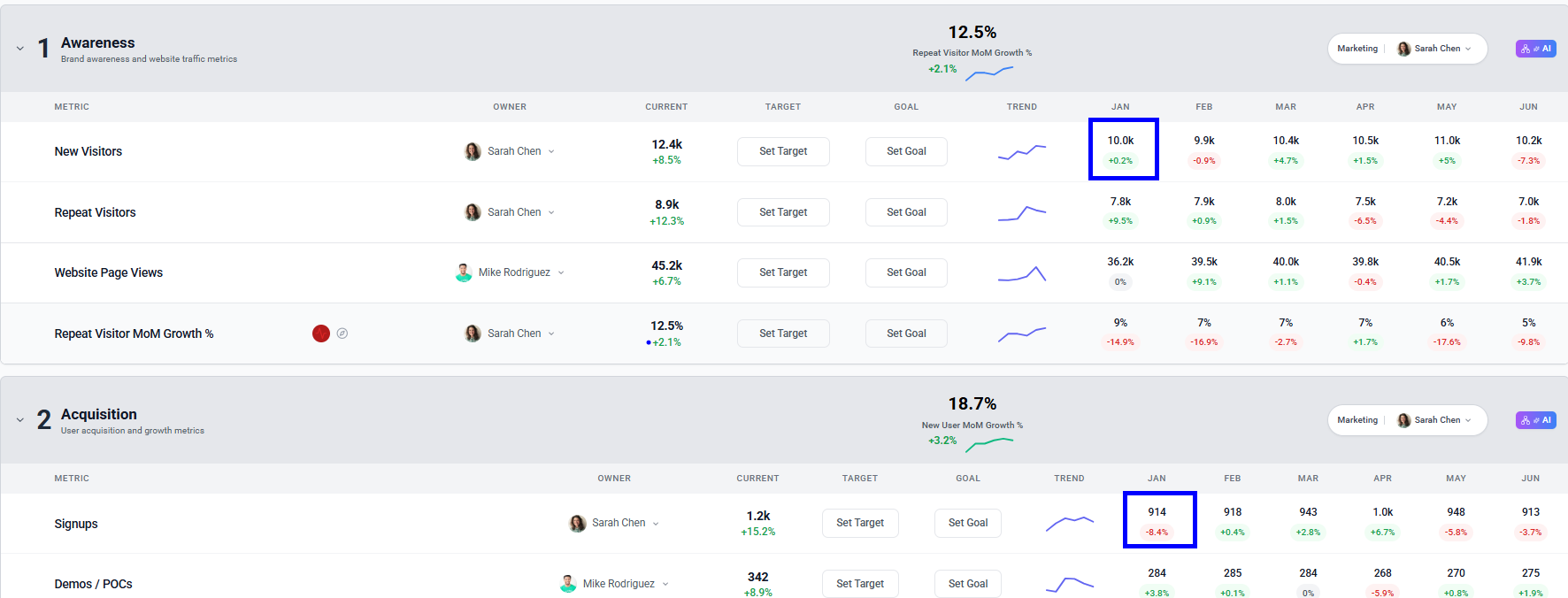
4. North Star Metric Tracking — Monitor any metric as a North Star metric. Start off with the Activation rate by default.
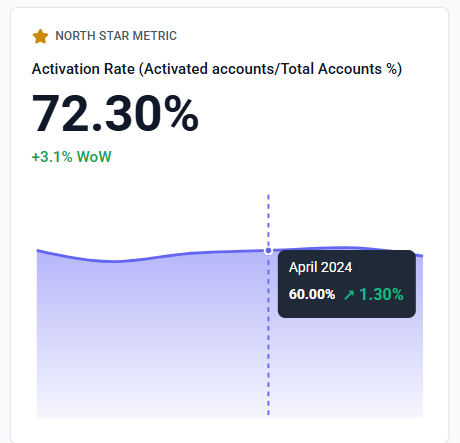
Customize by changing to any other metric your board decides to make as a new North Star, e.g. Net New MRR (BTW, revenue is usually a lagging metric, we recommend Activation or retention to be typically the more accurate ones for most PLG businesses)

5. Account & User-Level Insights — Understand high-signal actions that predict conversion, churn, or expansion.
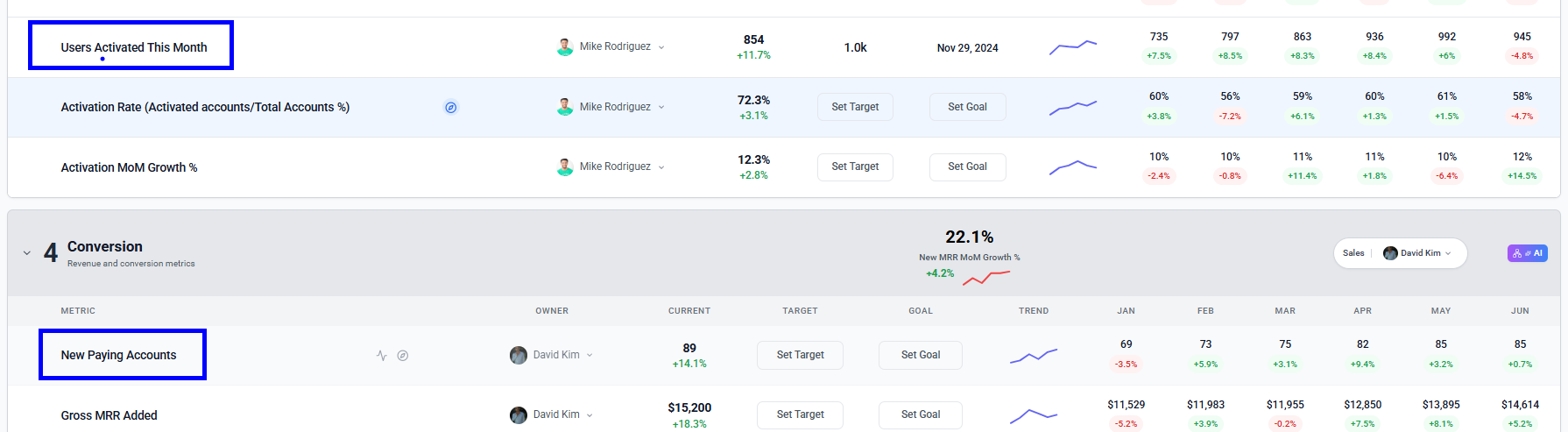

6. Unified Scorecard View — Replace siloed dashboards with one cohesive growth operating system.

How It Connects to the PMF Scorecard
The PLG Scorecard and the PMF Scorecard work in tandem to calibrate your business — learn more in our PMF announcement here:
Key Benefits
Topline Outcomes
- Improve self-serve activation by up to 40%
- Reduce churn-risk signals by 25%
- Boost product-led revenue contribution by 30–50%
Additional Business Outcomes
- Faster cross-team decision making
- Improved PLG pipeline efficiency
- Clear accountability for growth drivers
- Better resource allocation and experiment planning
- Consistent reporting for leadership and board reviews
Launch & Availability
The Self-Serve (PLG) Growth Scorecard is now available for all ThriveStack users.
Frequently Asked Questions
How does this relate to the PMF Scorecard?
The PLG Scorecard and PMF Scorecard work together — PLG monitors the full growth engine, while PMF validates product value consistency.
Who is this Scorecard for?
Revenue leaders, Growth teams (including Growth Product Managers, Growth Analysts, and Lifecycle Marketers), Product managers, RevOps, and Customer Success teams operating in a PLG motion and seeking full-funnel clarity.
What problems does it solve?
It unifies siloed metrics, surfaces hidden growth leaks, creates cross-functional alignment, and ensures every stage has a clear owner.
Does it require a complex setup?
No — the Scorecard is preconfigured with PLG best practices and connects seamlessly to ThriveStack’s Unified Data Layer.
Can small teams use it?
Absolutely — it removes the need for data engineering, custom dashboards, or spreadsheets.
How often does data update?
Continuously — ensuring real-time monitoring of activation, usage, and retention signals.
What makes ThriveStack different?
Correlation engines, unified account journeys, ownership assignment, and proactive GTM signals make it more powerful than traditional analytics or reporting tools.