AI citation gap analysis:
Find the sources that name rivals but not you
A citation gap is a source that AI engines cite for your prompts that names a rival but not you. List the cited domains per prompt, split them into owned and earned, and compare with your own presence. Each gap becomes an owned page to write or an earned mention to win.
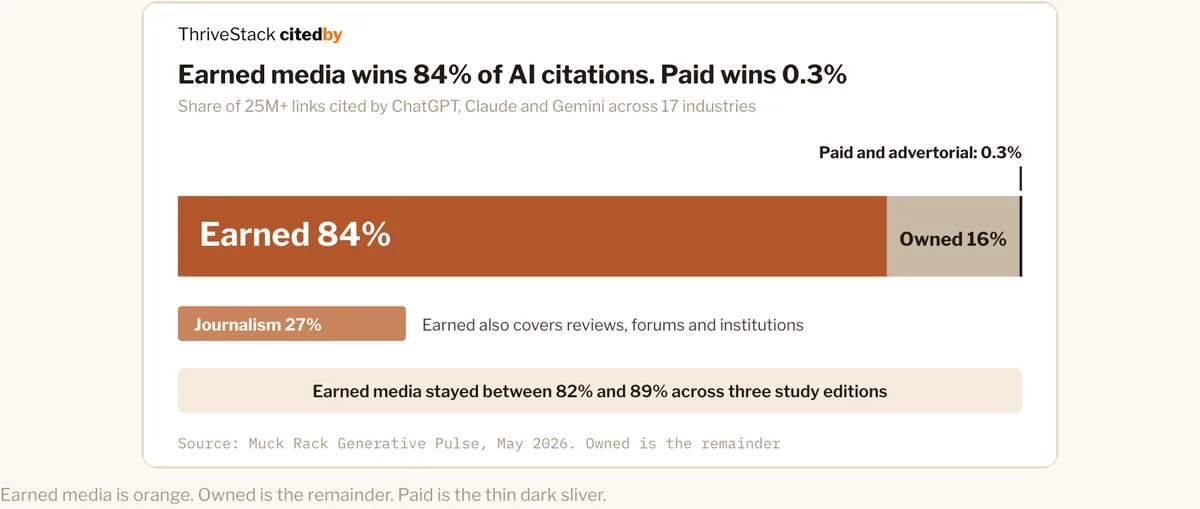
of AI citations go to earned media (vendor claim)
Muck Rack, May 8, 2026domains cited by ChatGPT are also cited by Perplexity
ThriveStack citedby researchof ChatGPT’s cited sources change every week
ThriveStack citedby researchof AI Overview cited URLs rank in the top 10
Ahrefs, Mar 2, 2026How do you run a citation gap analysis?
Collect cited URLs
Run each tracked prompt several times per engine and keep every cited URL. One run is not enough, since sources change run to run.
Group by domain and brand
Group URLs by domain, then note which brands each page names. Split domains into owned, competitor and earned.
Compare with your presence
Mark each domain where a rival is named and you are not. Those are your gaps.
Read the winning pages
Open each gap page and note what it has: a direct answer, a table, numbers, a date, the brands it names.
Close the gap
Write or fix an owned page where the gap is your own content. Pitch the site where the gap is earned.
How do you see who wins and why?
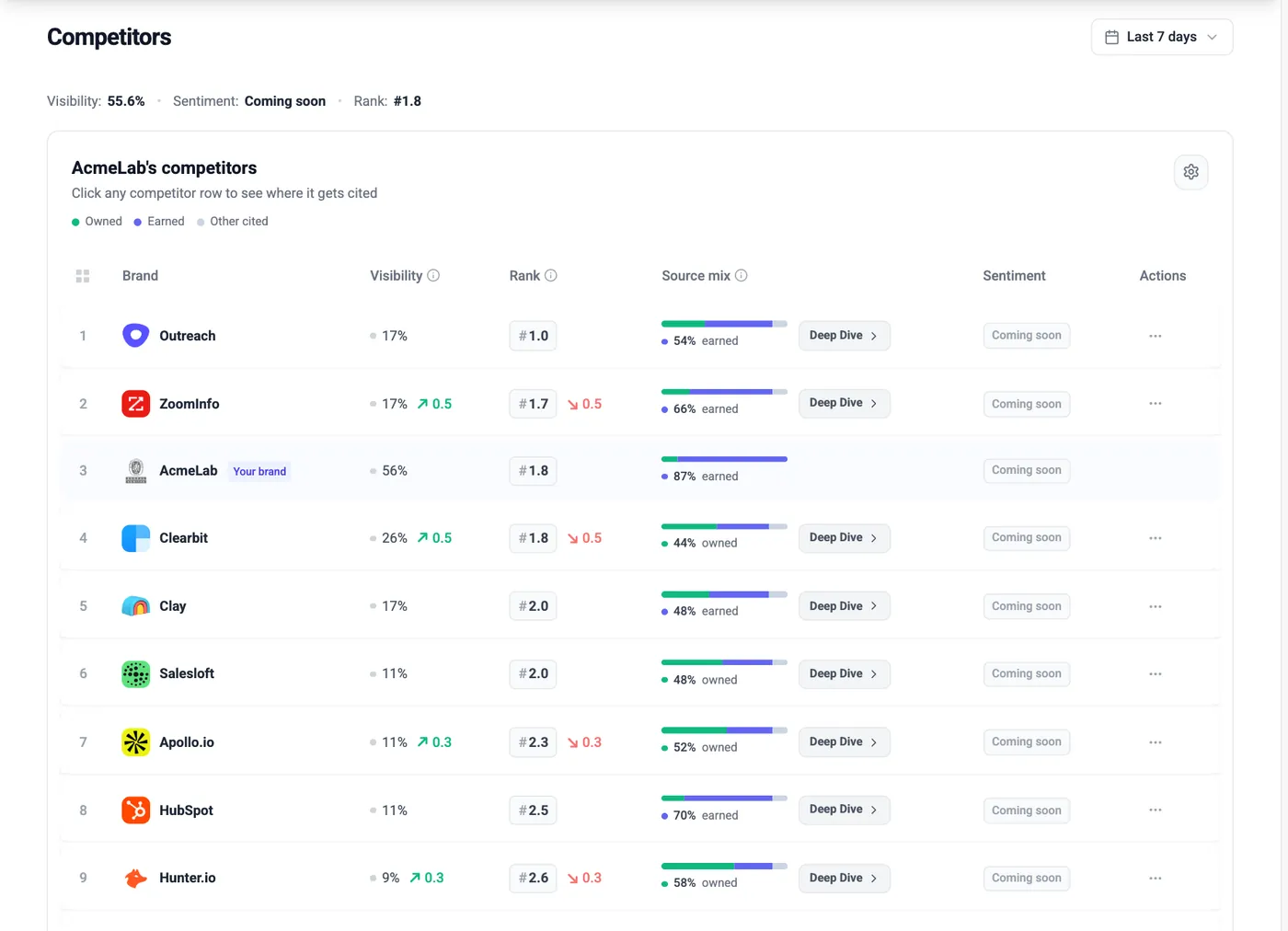
The Competitors page ranks every brand named for your prompts, with visibility, rank and where its citations come from. A good sign is your rank rising as gaps close. A warning sign is rivals winning mostly on earned sources you have not touched.
 123
- 1Your visibility and average rank across tracked prompts.
- 2Visibility per competitor.
- 3Source mix: owned against earned citations per brand.
Where do most AI citations come from?
Most citations go to third-party coverage, community threads and reference pages. That is why most gaps close off your site. Read the chart as a guide to where the work lands, then check your own prompts.
ThriveStack citedby collects the cited sources for every tracked prompt, shows the source mix per competitor and turns each gap into an owned or earned action.
All 10 questions this page answers.
These questions come from a query fan-out of "how to win AI search visibility". Each one has a short answer here, and the lesson above goes deeper.
Why competitors appear in AI answersTroubleshooting
They are on the sources engines retrieve: review sites, lists, Reddit threads or their own clear pages. Look at the cited sources for each prompt to see exactly why.
AI citation gap analysisInformational
Compare the sources engines cite for your tracked prompts with where you are present. Every source that names a rival but not you is a gap to close, through your own page or an earned mention.
How to compare AI share of voiceImplementation
Share of voice is your mentions as a share of all brand mentions across your tracked prompts. Compare it per engine and topic against named rivals, over the same runs and dates.
Competitor cited domains in ChatGPTInformational
Run your prompts several times, collect the cited URLs and group them by domain and by the brand each one names. ThriveStack citedby shows this on the Citations, Domains page.
How to reverse engineer AI citationsImplementation
Open each cited page and note what it has: a direct answer, a table, numbers, a date, an author, the brands it names. Then match or beat it on your page, or work to get onto that page.
Why a website is not cited by PerplexityTroubleshooting
Check that PerplexityBot is allowed and gets status 200, that content is in server HTML, and that you appear on the sources Perplexity cites, such as Reddit, Q&A and review sites.
How to find missing AI search topicsImplementation
Find prompts where rivals are cited and you have no page. Owned recommendations in ThriveStack citedby list these, with the competitors winning each one.
How to analyze competitor source coverageImplementation
List the domains that cite each rival, split them into owned and earned, and compare with yours. The Competitors page in ThriveStack citedby shows the source mix for every brand.
AI search citation overlap analysisInformational
Measure how many cited sources two engines or two brands share. Our research found only 11% source overlap between ChatGPT and Perplexity on the same prompt, so you need presence in several places.
How to identify competitor authority gapsImplementation
Where a rival has more reviews, press or original data on a topic, engines trust it more there. List those topics, then close each one with owned pages and earned mentions.
Sources for this lesson
- Muck Rack: Generative Pulse, earned media holds at 84% (May 8, 2026) Vendor claim, press release
- Ahrefs: AI Overview citations and the top 10 (Mar 2, 2026) 863K SERPs, 4M URLs
- Ahrefs: AI Overview brand correlation (May 26, 2025) 75,000 brands, vendor data
- ThriveStack: AI citation sources 2026 Our own research
- ThriveStack: AI trust signals engines reward Our own research
Figures were checked against each page on Nov 17, 2026. Vendor studies are labelled as vendor claims.