Query fan-out:
The hidden searches behind every AI answer
Query fan-out is how AI engines answer one prompt: they split it into sub-questions and run many searches at once, then build the answer from the results. Google says AI Mode does this, and ChatGPT search rewrites prompts into targeted queries too. To win, list the likely sub-searches and make sure a strong page answers each one.
of searches Deep Search in AI Mode can issue for one question
Google, May 20, 2025of AI Overview citations rank in the top 10, the rest come from deeper pages
Ahrefs, Mar 2, 2026of AI Overview citations rank beyond position 100 for the query
Ahrefs, Mar 2, 2026monthly Google searches for "query fan out", up 51% in a year
DataForSEO, Nov 2026What is query fan-out?
Google describes AI Mode as "breaking down your question into subtopics and issuing a multitude of queries simultaneously on your behalf." Google Search Central says AI Overviews and AI Mode may use the same technique. It is the most likely reason so many cited pages do not rank for the original query: they rank for a sub-search.
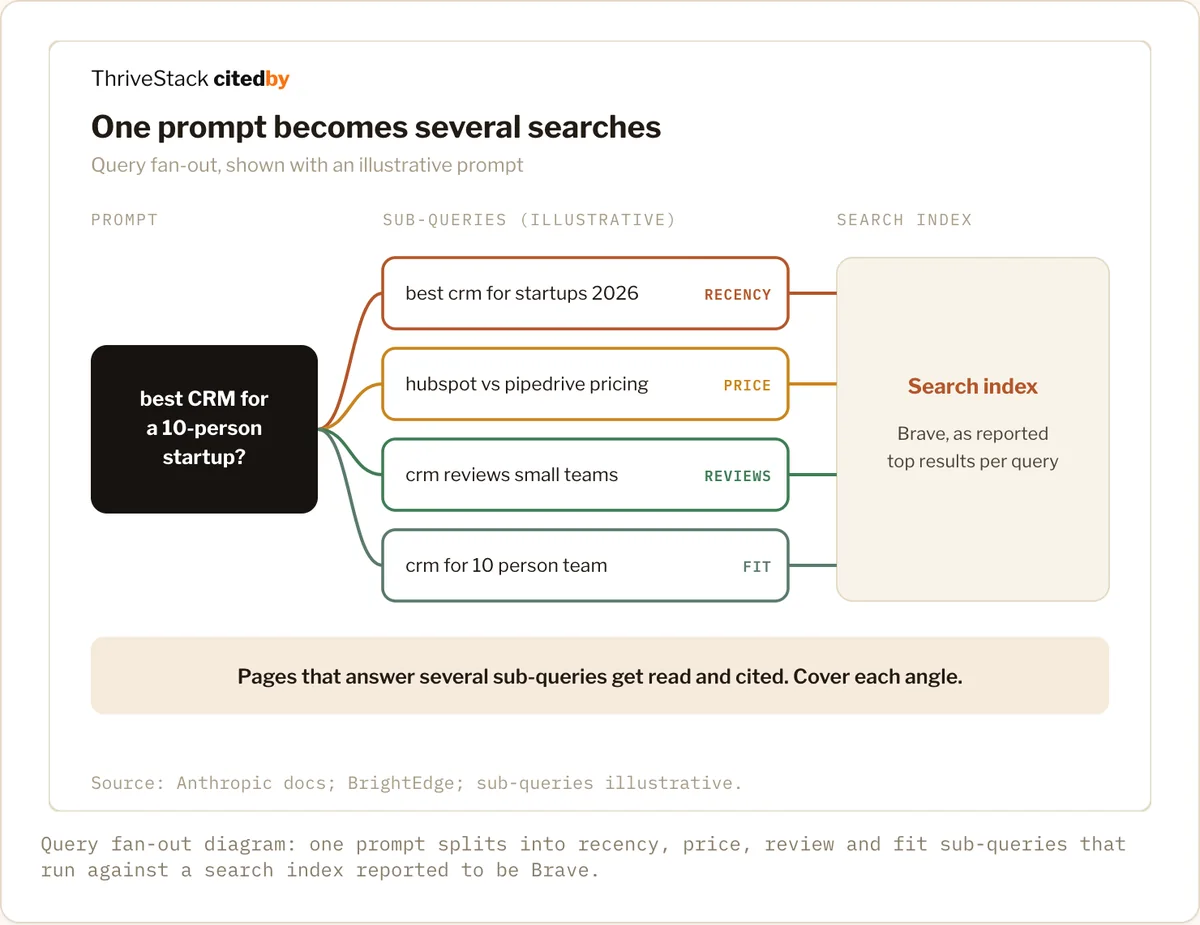
Here is what that looks like for one buyer prompt. "Best CRM for a 10-person startup?" splits into sub-searches for recency, price, reviews and fit, and each one runs against a search index. Pages that answer several of those angles get read and cited.
How do you list fan-out queries for a keyword?
Engines do not publish their sub-searches, so build a likely list from three places: related searches for the keyword, the follow-up questions in the AI answer, and the questions your sales team hears. For "best whatsapp mcp" that gives the eight searches below.
Query fan-out for "best whatsapp mcp":
One prompt, eight hidden searches
Sub-searches an engine could run for the prompt, from related Google searches and the follow-ups in ChatGPT’s answer.
- whatsapp mcp server
- whatsapp mcp claude
- whatsapp mcp github
- whatsapp business api mcp
- whatsapp mcp n8n
- meta whatsapp mcp
- composio whatsapp mcp
- whatsapp mcp ban risk
Source: DataForSEO related searches and ChatGPT answer, Nov 17, 2026. Engines do not publish their exact sub-searches.
Now try it for your own keyword. Type a search below and open it in ChatGPT. You get a likely fan-out tree to compare with the eight searches above.
Visualize the fan-out for your query:
Type a search, then open it in ChatGPT
Visualize the query fan-out for the search "best whatsapp mcp". List the hidden sub-queries an AI search engine would run to answer it, grouped by subtopic, with the intent of each one (informational, commercial or transactional). Show it as a tree, then name the type of page that would best answer each sub-query.
Opens ChatGPT in a new tab and runs the prompt. Its list is a likely fan-out, not the engine’s real sub-searches, so check it against the sources engines cite.
How do you cover the fan-out with content?
Map each sub-search to a page. Some will match a page you have. Others need a new section or a new page. The aim is that whichever sub-search the engine runs, it finds a clear answer from you.
Fan-out coverage plan for "best whatsapp mcp":
Each sub-search and the page that should answer it
| Sub-search | Best page type | What it must say |
|---|---|---|
| whatsapp mcp claude | Setup guide | Exact steps to connect, with a working config |
| whatsapp mcp github | GitHub README | What it does, install steps, license |
| whatsapp business api mcp | Comparison page | Official API vs linked-device tools, pros and cons |
| whatsapp mcp ban risk | FAQ or safety page | Plain answer on account risk and how to reduce it |
| whatsapp mcp n8n | Integration page | How to use it in an n8n workflow |
- Every sub-search has one clear page
- Each page opens with a direct answer
- Pages link to each other like a topic map
ThriveStack citedby shows the full answer for each tracked prompt, the brands named and the sources cited, so you can see which sub-questions your pages answer and which they miss.
Query fan-out, answered.
What is query fan-out?
The way AI engines split one question into many sub-searches and combine the results into one answer.
Does ChatGPT use fan-out?
OpenAI says ChatGPT search rewrites a prompt into one or more targeted queries and may send follow-up queries after reading the first results. We could not open the help page directly, so treat the detail as reported.
How many sub-searches does AI Mode run?
Google does not publish a number for normal AI Mode. It says Deep Search can issue hundreds.
Do I need special markup for fan-out?
No. Google says no special files or markup are needed for AI Overviews or AI Mode. Clear, indexed pages that answer each sub-question are what count.
All 10 questions this page answers.
These questions come from a query fan-out of "how to win AI search visibility". Each one has a short answer here, and the lesson above goes deeper.
How to map AI search prompts to topicsImplementation
Group prompts by the topic they ask about. Each topic becomes a cluster with one page. In ThriveStack citedby, topics on the Prompts page hold the prompts for each cluster.
How to reconstruct AI query fan-outImplementation
Engines do not publish their sub-searches, so build a likely list. Ask the engine what it would search, use a fan-out tool such as Qforia, check the grounding queries in Bing Webmaster Tools, then map each sub-search to a page.
How to find AI search prompt clustersImplementation
Collect prompts from prompt research, Search Console questions and sales calls. Group them by shared topic and intent. Ahrefs suggests keeping branded and unbranded prompts in separate clusters.
Informational vs commercial AI promptsCommercial
Informational prompts ask what or how, and AI often answers them in full, so few people click. Commercial prompts compare or choose tools, and they lead to shortlists and visits. Weight your tracking toward commercial prompts.
How to discover hidden AI search subtopicsImplementation
Read the pages engines cite and note the questions they answer. Check the follow-up questions engines suggest, related searches and fan-out tools. Each new question is a possible subtopic.
AI prompt taxonomy for SEOInformational
A prompt taxonomy labels each prompt by intent, persona, market, engine and branded or unbranded. It lets you report visibility by group instead of prompt by prompt.
AI search intent clusteringInformational
Group prompts by what the person wants to do: learn, compare, buy or fix something. Each intent needs a different page type, from explainer to comparison to pricing page.
How to prioritize AI visibility promptsImplementation
Rank prompts by buying intent, business value and how winnable they are, based on who is cited now. Start with unbranded commercial prompts.
How to identify AI search retrieval gapsImplementation
A retrieval gap is a prompt where engines retrieve pages but none are yours. Compare the cited domains for each prompt with your own pages to find them.
Query fan-out analysis examplesInformational
For "best whatsapp mcp", an engine may also search setup steps, pricing, open-source options, security and comparisons. Lesson 1.5 lists eight likely sub-searches and the page that should answer each.
Sources for this lesson
- Google: AI Mode update, Elizabeth Reid (May 20, 2025) Fan-out and Deep Search
- Google Search Central: AI features and your website Checked Nov 17, 2026
- Ahrefs: AI Overview citations and the top 10 (Mar 2, 2026) 863K SERPs, 4M URLs
- OpenAI Help Center: ChatGPT search Not opened directly, seen in search results
Figures were checked against each page on Nov 17, 2026. Vendor studies are labelled as vendor claims.