Content structure for AI answers:
Make every page easy to quote
AI engines lift short, clear passages. Open each page and section with a direct answer of 40 to 60 words, use question headings, add sourced numbers and quotes, and use tables and numbered steps. In the GEO study, adding quotations, statistics and sources raised visibility the most. Keyword stuffing did worse than doing nothing.
visibility boost in generative engine answers from GEO methods
GEO paper, KDD 2024visibility gain from citing sources, for the lowest-ranked sites
GEO paper, Jun 28, 2024fresher: AI-cited pages vs organic results, by average age
Ahrefs, Jul 28, 2025content and SEO checks passing in the demo workspace
ThriveStack citedby demo, Nov 2026What makes a passage easy for AI to quote?
The GEO study tested changes on 10,000 queries. Quotations, statistics, fluent writing and cited sources helped most. Keyword stuffing scored below the baseline. The gains were biggest for smaller sites, which suggests structure matters most when you lack authority.
- A 40 to 60 word direct answer under each heading
- Question headings that match how buyers ask
- A number with a named source and date in each section
- Tables for comparisons and numbered lists for steps
- A visible last-updated date, with real updates
What does the Content and SEO audit check?
The Content and SEO tab checks whether AI can extract clear answers from each page. A good sign is passing direct-answer and heading checks on your top pages. A warning sign is Fail on pages that already get AI crawler visits, because those are the cheapest wins.
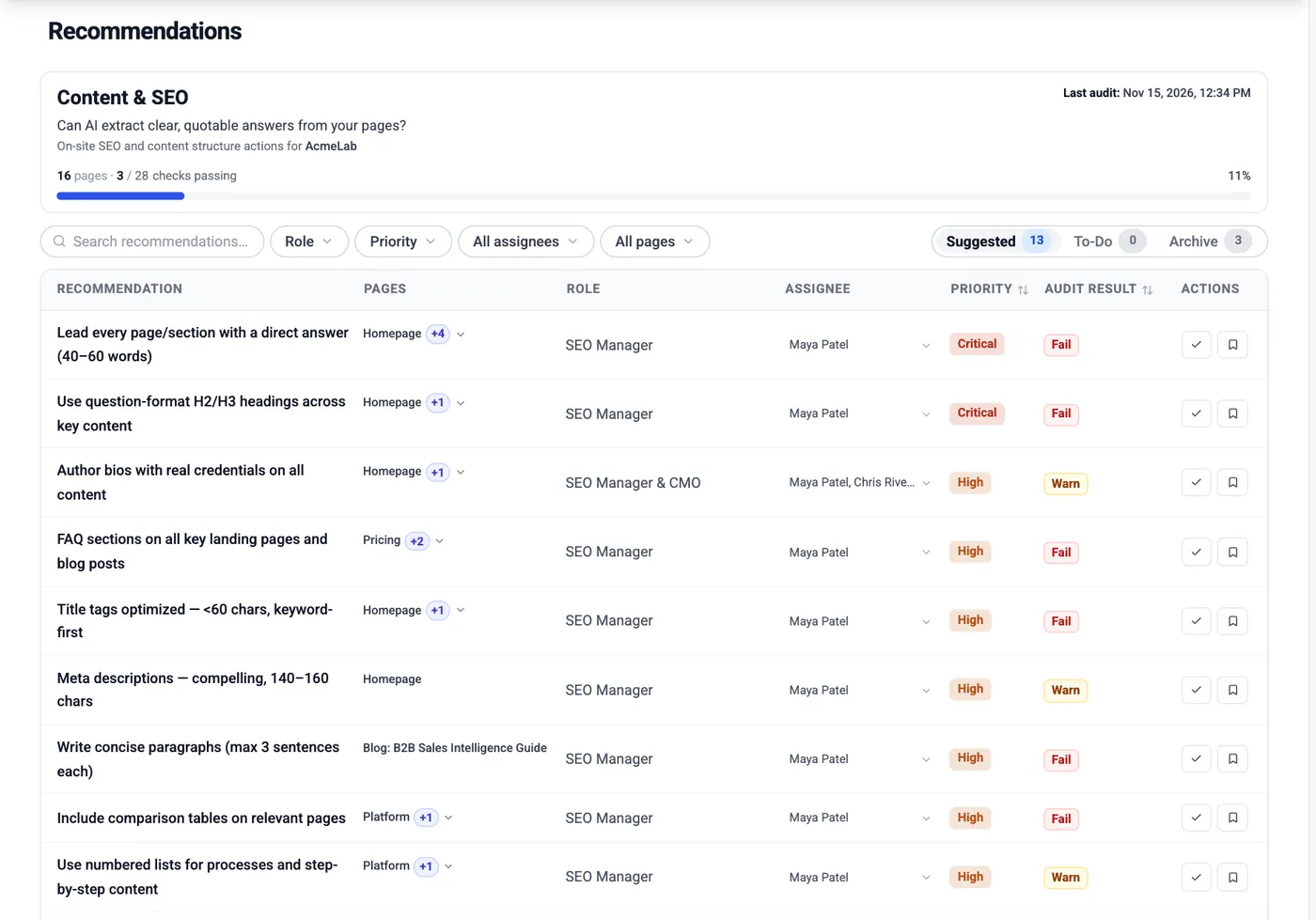 1234
- 116 pages audited, 3 of 28 checks passing.
- 2Lead every page or section with a direct answer of 40 to 60 words.
- 3Use question-format H2 and H3 headings.
- 4Fail or Warn per check, from the last audit.
What does a quotable opening look like?
Before and after:
A page opening AI can quote
| Text | |
|---|---|
| Before | In today’s fast-moving world of messaging, many teams wonder how AI and WhatsApp can work together. |
| After | A WhatsApp MCP server lets an AI assistant such as Claude read and send WhatsApp messages. The main options are linked-device tools like WAHA and the official Meta Cloud API. Linked-device tools are faster to set up. The official API is safer for business use. |
Research for this lesson.
Our own studies behind this lesson. Each one has the key charts and numbers, and a link to the full article.
ThriveStack citedby audits each page for direct answers, question headings, sourced numbers and structure, and ranks the content fixes by the prompts they affect.
Content structure for AI answers, answered.
How long should the direct answer be?
About 40 to 60 words. Long enough to stand alone, short enough to quote whole.
Does schema markup help AI answers?
Google says no special schema is needed for AI Overviews or AI Mode. Schema still helps engines understand entities, which lesson 3.2 covers.
Does freshness matter?
Ahrefs found AI-cited pages were 25.7% fresher on average than organic results. Update pages with real changes, not just a new date.
All 30 questions this page answers.
These questions come from a query fan-out of "how to win AI search visibility". Each one has a short answer here, and the lesson above goes deeper.
Does schema markup improve AI visibility?Informational
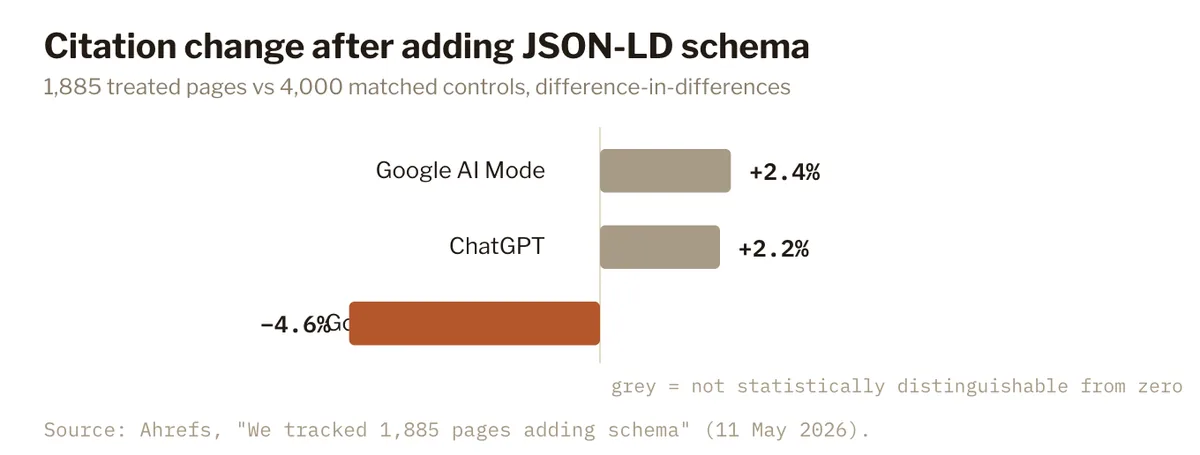
Not on its own, in the tests we found. Three controlled studies saw no citation lift from adding schema, including a 4.6% drop for AI Overviews. Google says no special markup is needed for AI features. Schema still helps Google understand your organization and products.
Organization schema for AI searchInformational
Google says Organization markup helps it understand your company and tell it apart from others, and that sameAs links point to your other profiles. Add name, logo, url, sameAs and contact details on your home or about page, and keep them true.
Product schema and AI recommendationsInformational
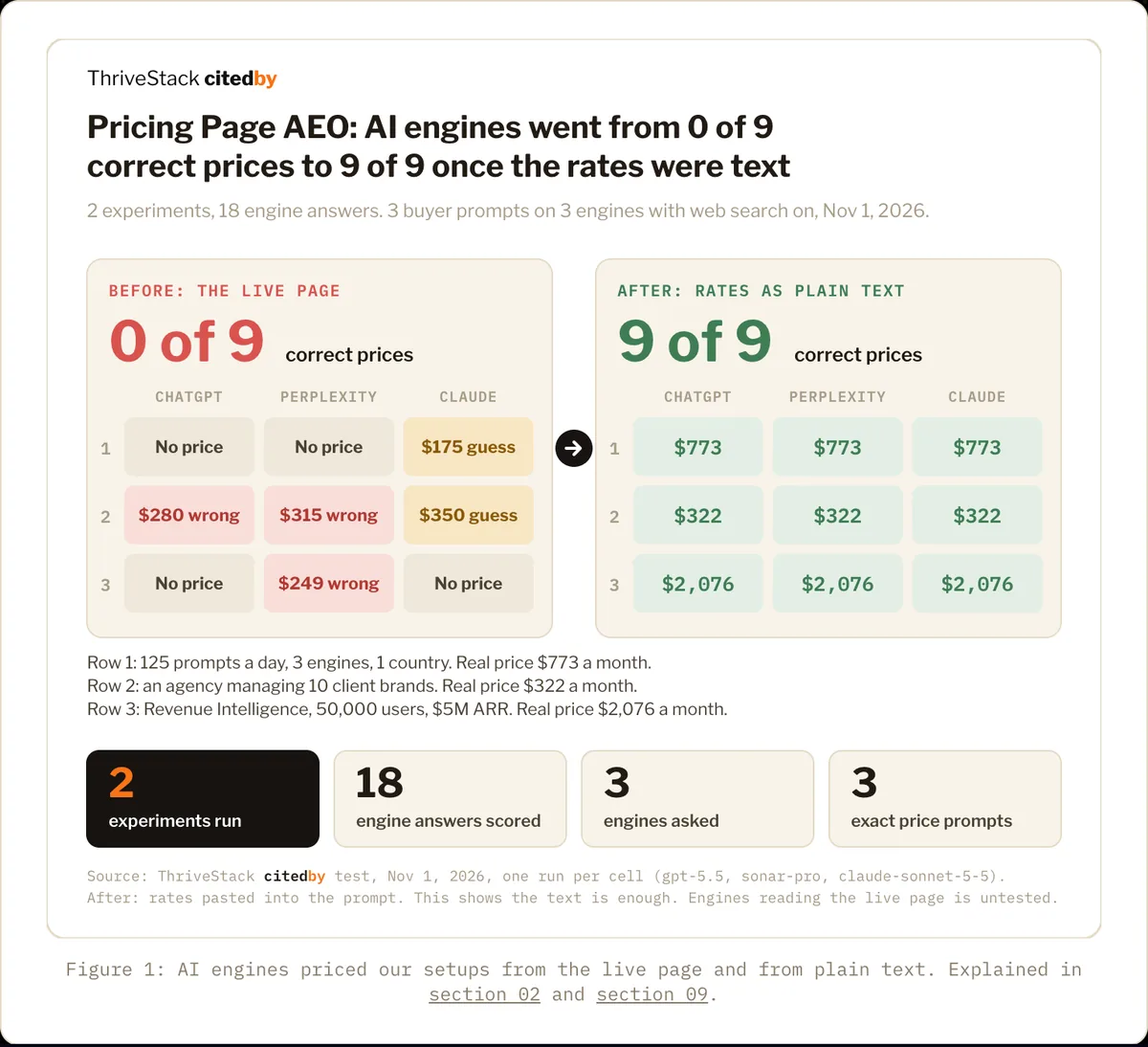
Product markup describes price, offers and reviews for Google’s rich results. But our research found 0 of 5 AI systems pulled a price that was hidden only in JSON-LD. Show prices, specs and fit as visible text, and keep the markup matching it.
FAQ schema for AI searchInformational
FAQ markup can describe question and answer pairs, but no controlled test we found shows it raises AI citations. Engines quote the visible questions and answers. If you use it, keep it identical to the text on the page.
Article schema and author informationInformational
Article markup with author, dates and publisher tells engines who wrote a page and when. Show the same author name, role and dates on the page itself, and link the author to a profile page, since the visible facts are what engines read.
JSON-LD AI search best practicesCommercial
Use JSON-LD, keep it matching the visible text, and validate it. Cover Organization with sameAs, Article with author and dates, and Product with offers. Our research found cited pages are about 3 times likelier to carry JSON-LD, but adding it alone did not lift citations in tests.
HTML tables for AI retrievalInformational
Real HTML tables give engines clean rows and columns to quote, which suits comparisons, specs and prices. Avoid tables made of images or built only by JavaScript. In our pricing test, engines went from 0 of 9 to 9 of 9 correct prices once the rates were plain text.
Semantic HTML for AI answersInformational
Use one H1, question-style H2s, plain paragraphs, lists and tables instead of styled divs. Clear structure tells a retrieval system where each answer starts and ends, so it can lift one passage cleanly.
Do llms.txt files improve AI visibility?Informational
There is no proof it helps today. Google’s John Mueller said no AI system currently uses llms.txt, and Google says no special AI files are needed for AI Overviews or AI Mode. It does no harm, so treat it as optional.
How to structure content for AI extractionImplementation
Open each section with a 40 to 60 word answer under a question heading. Add a sourced number in each section. Use tables for comparisons and numbered lists for steps. Show a real last-updated date.
How to write content AI engines citeImplementation
Answer the question in the first lines, back it with a number and a named source, add an expert quote, and keep facts current. The GEO paper found statistics, quotations and cited sources raised visibility the most.
Answer-first content for AI searchInformational
Answer-first content puts the direct answer at the top of the page and of each section, then the detail. Engines lift short passages, so each answer should make sense on its own.
Best paragraph structure for AI answersCommercial
Write a 40 to 60 word paragraph that answers the heading in its first sentence, then add one fact with its source. Keep one idea per paragraph.
How to optimize headings for AI searchImplementation
Write headings as the questions buyers ask, one topic per heading, with the key term in it. Then answer directly below the heading.
Should AI content use question headings?Informational
Yes, where it fits. Question headings match how people prompt AI and mark where each answer starts. The Content and SEO audit in ThriveStack citedby checks for question-format H2 and H3 headings.
How to write definitions for GEOImplementation
Use the pattern "X is a Y that does Z" in one or two sentences near the top of the page, before any history or detail. Then add one example.
Comparison tables for AI citationsInformational
Tables put options side by side, which suits "best" and "vs" prompts. Use a real HTML table with clear headers and units, source each claim, and date the table.
How-to steps for AI search optimizationInformational
Use numbered steps, one action each, starting with a verb, and say what the reader should see after the step. Engines can quote a clean list as it is.
Content chunking for AI retrievalInformational
Break a page into sections that each answer one question under its own heading. A retrieval system can then pull one section without the rest of the page.
How to make answers easy to verifyImplementation
Name the source and date for every number and link to it. Show the author and last-updated date. Keep the same facts on every page and profile, so an engine can check one against another.
Do images improve AI search visibility?Informational
Images alone are rarely quoted in text answers. Give each image alt text and a caption, and state its key fact in the page text too.
Video SEO for AI answersInformational
Publish a transcript and chapters, write a clear title and description, and summarize the video on the page. Engines read text about a video more easily than the video itself.
YouTube content in AI search recommendationsInformational
YouTube videos show up among the sources some engines cite, and AI Overviews lean on video and forums. Clear titles, descriptions and full transcripts make videos easier to match to a prompt.
Product feeds for Google AI ModeInformational
Merchant Center feeds supply product data to Google’s shopping features. Keep titles, prices and stock accurate. Google had not detailed how AI Mode uses feeds in the sources we checked.
Merchant Center AI search visibilityInformational
Keep your Merchant Center feed accurate and matching your product pages, since Google uses it for shopping results. How AI Mode weighs feed data is not documented in the sources we checked.
Image alt text and AI discoveryInformational
Alt text describes an image to crawlers that cannot see it. Write what the image shows and the key fact, in plain words, without stuffing keywords.
PDF indexing for AI searchInformational
Google can index PDFs, but HTML pages are easier to quote, update and track. Publish the key findings as an HTML page and link the PDF from it.
Infographics as AI citation sourcesInformational
Engines cite text. Put every number from the infographic in page text, with its source and date, right next to the image.
Product specifications in AI answersInformational
Put specs in an HTML table with units, in plain text. Our research found AI systems did not pick up a price hidden only in JSON-LD, so visible text matters.
How to make video transcripts AI discoverableImplementation
Publish the full transcript on the page as HTML, add chapters and a short summary, and link the page from the video description.
Sources for this lesson
- Aggarwal et al.: GEO, Generative Engine Optimization (KDD 2024) Princeton and partners
- GEO paper, full text v3 (Jun 28, 2024)
- Ahrefs: Do AI assistants prefer fresh content? (Jul 28, 2025) 17M citations
- Google Search Central: AI features and your website Checked Nov 17, 2026
Figures were checked against each page on Nov 17, 2026. Vendor studies are labelled as vendor claims.