How AI engines pick sources:
Retrieval, fan-out and five engines compared
AI engines turn a prompt into one or more searches, retrieve pages, pick the passages that answer best and cite some of them. Each engine reads a different mix of sources: our research found only 11% source overlap between ChatGPT and Perplexity. So do the shared basics once, then plan sources per engine.
of AI Overview cited URLs also rank in Google’s top 10
Ahrefs, Mar 2, 2026of searches Deep Search in AI Mode can issue for one question
Google, May 20, 2025source overlap between ChatGPT and Perplexity on the same prompt
ThriveStack citedby researchruns where ChatGPT or Google AI repeat the same brand list
SparkToro, Jan 28, 2026What happens between a prompt and a citation?
Every engine that searches the web follows the same rough path. It rewrites the prompt into searches, retrieves pages, picks the passages that answer best and writes one answer. Only pages that are retrieved can be cited, which is why crawl access and clear passages come first.
Rank still helps, but it does not decide the outcome. Ahrefs found only 37.9% of URLs cited in AI Overviews ranked in the top 10 for the same query. A clear passage on page two can beat a vague page on page one.
When does an engine search, and when does it answer from memory?
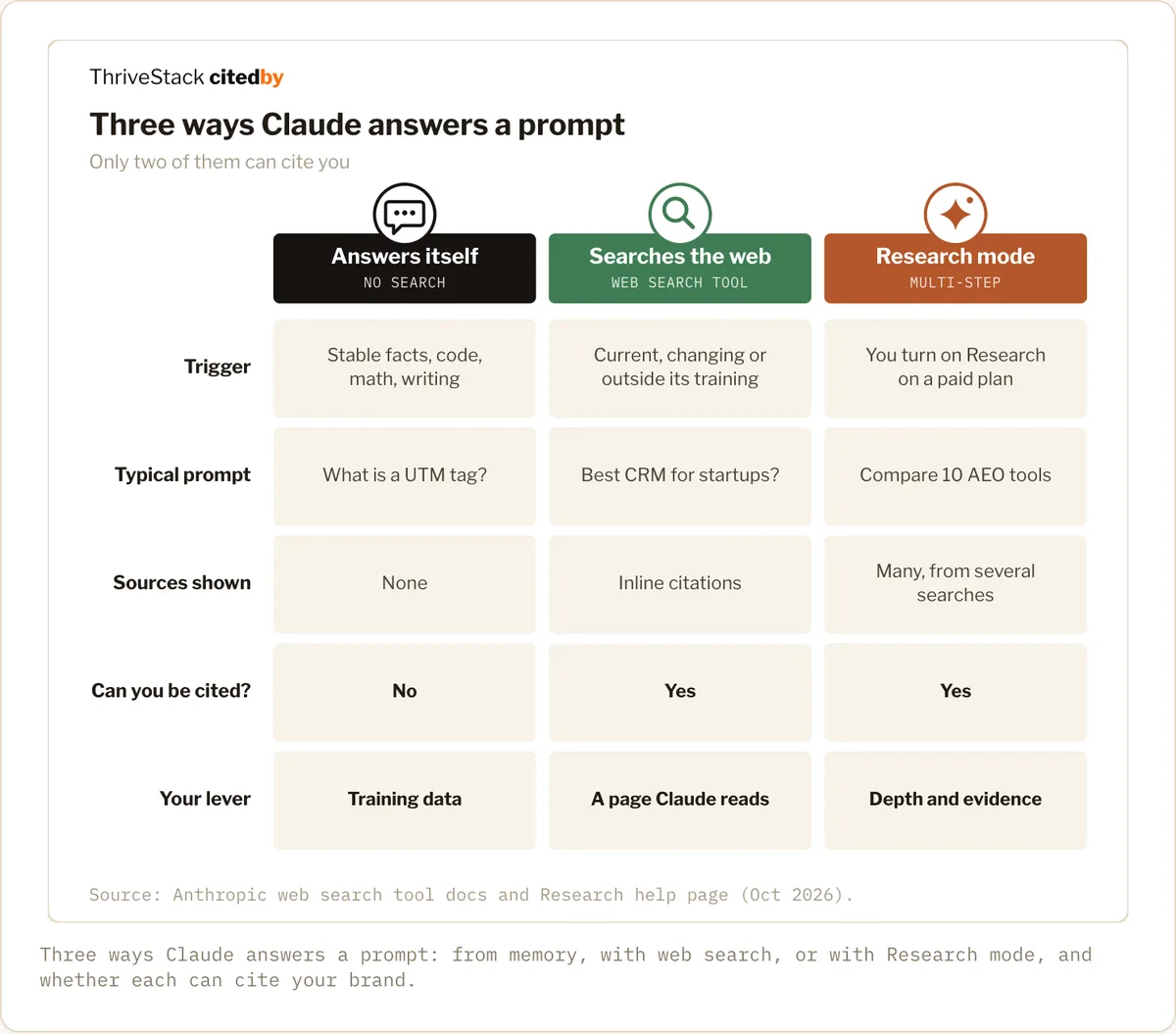
Engines answer stable questions from what the model already knows and search for current ones. Our Claude research found the same split: only answers that search can cite your pages. Prompts with "best", "2026", pricing or comparisons tend to trigger a search, so those are the ones to win.
Which domains do engines retrieve for your prompts?
Each engine retrieves a different mix of domains, so one source plan for all of them underperforms everywhere. The visual comes from our AI citation sources research. Read down a column for one engine: where to earn presence, the format to build, how many domains it cites per answer, how fast it forgets, and what to skip. Start with the engines your buyers use.
 ChatGPT |  Perplexity |  Gemini |  AI Overviews |  Claude | |
|---|---|---|---|---|---|
| Earn presence in | Trade pressWikipediaNewswire | RedditQ&A sitesB2B reviews | InstitutionsVendor docsDirectories | YouTubeForumsSchema pages | National pressReview sitesComparison blogs |
| Format to build | Reference explainers with sourced numbers | Question-shaped threads and comparisons | Structured, list-style documentation | Long-form video with clean transcripts | Precise, evidence-dense pages |
| Domains per answer | 3.1 | 6.4most slots | 2.4fewest slots | Not reported | 3.6 |
| Recency | 56%of journalism cited is under a year old | 3.2xcitations for content under a year old | Not reported | Not reported | 36%under a year old, the longest tail |
| Skip | Paid placements | Wikipedia | Forums | Short video | Thin pages |
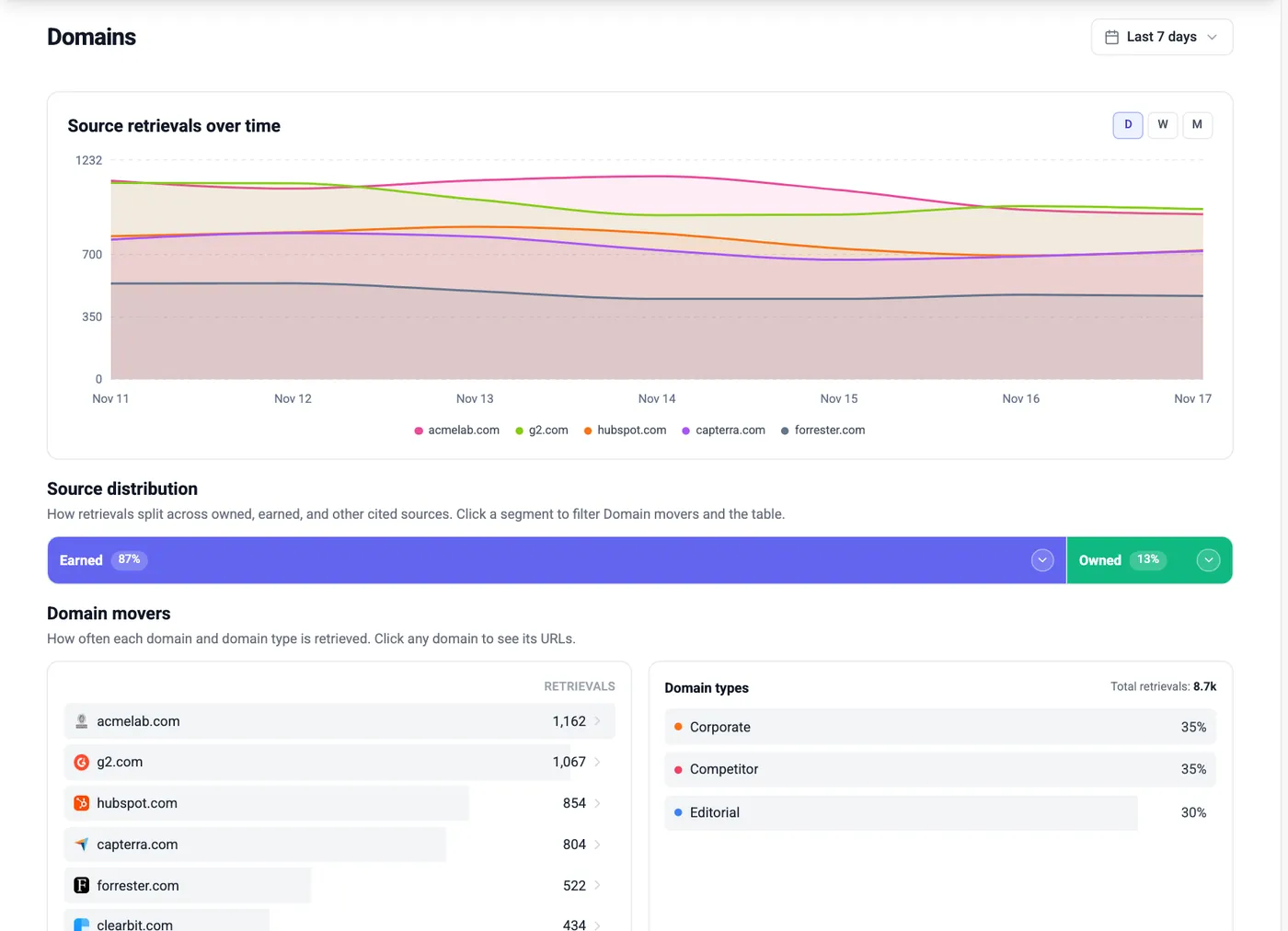
The Citations, Domains page shows which domains engines retrieve for your tracked prompts and how the split falls between owned and earned. A good sign is your own domain among the top retrievals. A warning sign is one engine citing you while the others never do.
 123
- 1Source retrievals over time for the most cited domains.
- 2Source distribution: earned against owned.
- 3Domain movers: which domains engines retrieve most.
Research for this lesson.
Our own studies behind this lesson. Each one has the key charts and numbers, and a link to the full article.
ThriveStack citedby runs your prompts on ChatGPT, Perplexity, Gemini and AI Overviews, and shows which domains each engine retrieves and cites.
All 20 questions this page answers.
These questions come from a query fan-out of "how to win AI search visibility". Each one has a short answer here, and the lesson above goes deeper.
How does ChatGPT Search find sources?Informational
ChatGPT search looks up the web for the prompt and reads the pages it finds. OpenAI says OAI-SearchBot powers search and that sites which block it will not appear in ChatGPT search answers. ChatGPT-User fetches a page live when a user’s question needs it.
How does Google AI Mode retrieve content?Informational
Google says AI Mode uses query fan-out: it breaks a question into subtopics and runs many searches at once, and Deep Search can issue hundreds. It draws on Google’s index, so a page must be indexed and eligible to show with a snippet.
How does Perplexity select citations?Informational
Perplexity searches the web for each question. Its PerplexityBot surfaces and links sites and, Perplexity says, is not used to train foundation models. In our own sample, Perplexity listed 19.2 sources per answer against 3.6 for Claude, so it gives more slots to win.
What is query fan-out in AI search?Informational
Query fan-out is when an engine splits one prompt into several related searches, runs them at once and builds one answer from the results. Google confirms AI Mode and AI Overviews may use it. It helps explain why pages outside the top 10 still get cited.
How does retrieval augmented generation work?Informational
Retrieval augmented generation means the model first retrieves documents for a question, then writes its answer from them. AI search engines work this way when they search the web, which is why your pages must be easy to find and easy to quote.
How do AI engines rank sources?Informational
No engine publishes its rules. A page must first be retrieved by the engine’s search, then picked as useful for the answer. Ahrefs found only 37.9% of AI Overview citations ranked in Google’s top 10 for the same query, so a clear passage can beat a high rank.
How do AI models select evidence?Informational
They favor passages that answer the question directly and carry facts they can check. The GEO paper found that adding statistics, quotations and cited sources raised visibility most, while keyword stuffing did worse than doing nothing.
What is citation absorption in AI answers?Informational
It is not a standard term. People use it for answers that use a source’s facts or name a brand without linking to it. Our research found ChatGPT names brands about 3.2 times more often than it cites them, so track mentions as well as links.
Why do AI answers vary between runs?Troubleshooting
Models pick words with some randomness, and each run can retrieve different pages. SparkToro found ChatGPT or Google AI gave the same brand list less than 1 in 100 times across 2,961 runs (Jan 2026). Measure visibility as a share of many runs.
How does AI search grounding work?Informational
Grounding ties an answer to retrieved sources, such as web pages, so the model works from current facts instead of memory. Our Claude research found Claude answers stable questions from memory and searches only for current ones. Only answers that search can cite you.
ChatGPT vs Google AI Mode visibilityCommercial
They pull from different places. AI Mode runs fan-out searches on Google’s index. ChatGPT search uses OpenAI’s own crawler and search. Even Google’s surfaces differ: our research found only 27% brand overlap between Gemini and AI Overviews. Track each engine on its own.
Perplexity vs ChatGPT citation selectionCommercial
They cite different sources. Our research found only 11% source overlap between ChatGPT and Perplexity on the same prompt. Perplexity also lists more sources per answer and leans on Reddit, Q&A and review sites, while ChatGPT leans on press and reference pages.
Gemini vs Google AI Overviews optimizationCommercial
Both draw on Google Search but pick different sources: our research found 27% brand overlap. Google says there is no special optimization for AI Overviews, so indexing, direct answers and mentions on the sites each one reads decide both.
Best strategy for multiple AI enginesCommercial
Do the shared basics once: allow each engine’s search crawler, render content on the server, write direct answers with sources and keep facts consistent. Then plan sources per engine, because each one cites a different mix, and track each engine separately.
How to optimize for ChatGPT SearchImplementation
Allow OAI-SearchBot and ChatGPT-User, put key content in server HTML, keep facts current and earn coverage in the press and reference sites ChatGPT cites. Ahrefs found ChatGPT cited the freshest pages of the assistants it studied.
How to optimize for Google AI ModeImplementation
Google says there are no extra requirements: be indexed, allowed for Googlebot and eligible for a snippet. Then answer each subtopic the fan-out will search, such as pricing, setup and comparisons, so one of your pages matches each sub-search.
How to optimize for PerplexityImplementation
Allow PerplexityBot, keep content readable without JavaScript and earn presence where Perplexity reads. In the sources our Reddit playbook draws on, Reddit appeared in 46.7% of Perplexity answers. Question-shaped threads and comparison answers fit it best.
How to appear in Claude answersImplementation
Allow Claude-SearchBot and Claude-User. Anthropic says blocking them may reduce visibility in Claude’s search answers. Claude searches mostly for current questions, such as "best" lists and pricing, and favors precise, evidence-dense writing.
How to appear in Microsoft CopilotImplementation
Copilot draws on Bing. Submit a sitemap with accurate lastmod dates, use IndexNow and check the AI Performance report in Bing Webmaster Tools, which shows citations and cited pages across Copilot and Bing AI summaries.
Cross-engine AI search visibility checklistImplementation
Allow the search crawlers (OAI-SearchBot, PerplexityBot, Claude-SearchBot, Googlebot, Bingbot). Server-render content. Keep a sitemap with lastmod and use IndexNow. Write direct answers with sourced numbers. Keep entity facts consistent. Earn mentions per engine. Track each engine on its own.
Sources for this lesson
- Google: AI Mode update, Elizabeth Reid (May 20, 2025) Fan-out and Deep Search
- Google Search Central: AI features and your website Checked Nov 17, 2026
- Ahrefs: AI Overview citations and the top 10 (Mar 2, 2026) 863K SERPs, 4M URLs
- SparkToro: AIs are highly inconsistent when recommending brands (Jan 28, 2026) 2,961 runs
- OpenAI: Overview of OpenAI crawlers Checked Nov 17, 2026
- Perplexity: Perplexity crawlers Checked Nov 17, 2026
- Anthropic: Does Anthropic crawl data from the web Updated Oct 30, 2026
- Bing Webmaster Blog: AI Performance in Bing Webmaster Tools (Feb 10, 2026)
- ThriveStack: AI citation sources 2026 Our own research
- ThriveStack: How to get your brand mentioned in Claude Our own research
Figures were checked against each page on Nov 17, 2026. Vendor studies are labelled as vendor claims.