Prompt research for AI search:
Turn one keyword into the prompts buyers ask
Prompt research finds the full questions buyers ask AI about your category, then keeps the ones worth tracking. Start from your keyword, your domain and your competitors. Tag each prompt by topic, persona and intent, keep branded and unbranded prompts apart, and track 20 to 100 commercial prompts.
average length of a search-enabled ChatGPT prompt, up from 4.7 (vendor claim)
Semrush, Apr 7, 2026of ChatGPT prompts matched no traditional keyword (vendor claim)
Semrush, Apr 7, 2026of ChatGPT conversations are practical guidance, seeking information or writing
NBER working paper, Sep 2025similarity between 142 people’s prompts on the same topic
SparkToro, Jan 28, 2026How does prompt research work in ThriveStack citedby?
Step through the interactive demo. It shows how ThriveStack citedby researches buyer questions from your brand, keywords or topics, tags every prompt and lets you choose which ones to track.
What does a prompt research run show?
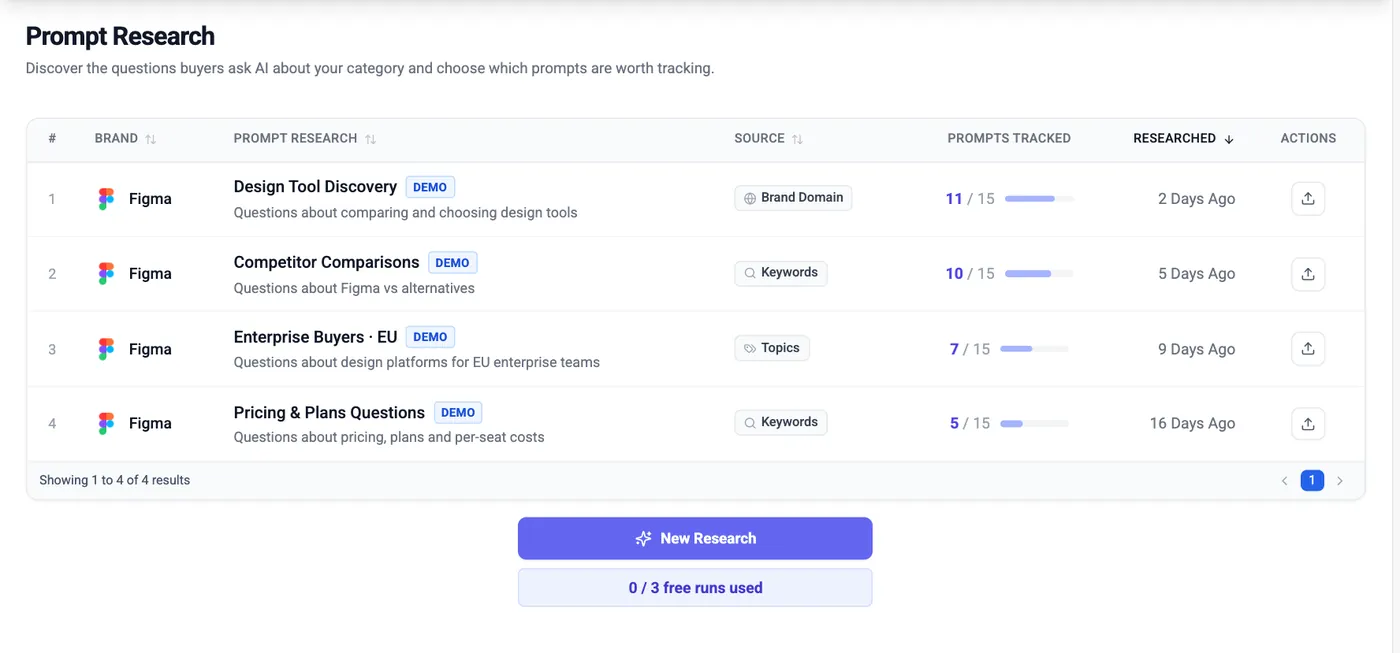
Each research run starts from a source: your brand domain, a keyword list or a set of topics. The run lists the questions buyers ask and how many you chose to track. A good sign is a mix of comparison, pricing and "best X" questions. A warning sign is a list full of branded questions, which tell you little about new buyers.
 1234
- 1Each research groups buyer questions, such as competitor comparisons or pricing.
- 2The source each run started from: brand domain, keywords or topics.
- 3How many of the researched prompts you chose to track.
- 4Start a new research run.
Which prompts should you keep?
Keep prompts that a buyer would ask before a purchase. Group them in clusters and keep branded prompts in their own cluster, because naming your brand in the prompt almost guarantees you show up.
Prompt types to keep for "best whatsapp mcp":
Intent, example and why it matters
| Type | Example prompt | Why keep it |
|---|---|---|
| Best of | What is the best WhatsApp MCP server for Claude? | The answer is a short list. Being on it is the win. |
| Use case | How do I connect WhatsApp to an AI agent? | Shows the job to be done, and which tools engines suggest. |
| Comparison | WAHA vs Meta Cloud API for an MCP | Engines quote comparison pages directly. |
| Risk | Is a WhatsApp MCP safe, can my number get banned? | Trust questions decide the final pick. |
| Branded | Is Automata WhatsApp MCP any good? | Track separately. It inflates your visibility. |
How do you add many prompts at once?
In the app, go to AI Visibility, then Prompts, then Add prompt, then the Bulk Upload tab. Download the CSV template, fill in Prompt and an optional Topic, match the columns and import. Duplicates and blank rows are skipped.
Research for this lesson.
Our own studies behind this lesson. Each one has the key charts and numbers, and a link to the full article.
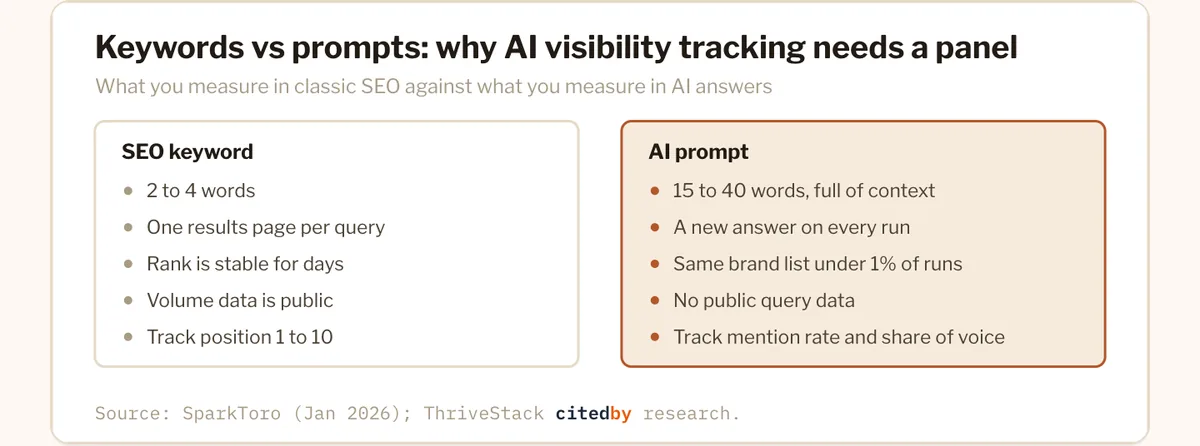
ThriveStack citedby researches the prompts buyers ask from your domain, keywords or topics, tags each one by persona and intent, and tracks the ones you pick across AI engines.
Prompt research for AI search, answered.
What is prompt research?
Finding the full questions buyers ask AI engines about your category, and choosing which ones to track.
How many prompts should I track?
Ahrefs suggests starting with a few dozen. Track 20 to 100 commercial prompts, then grow once you see which clusters move.
Should I track branded prompts?
Yes, but in their own cluster. Mixing them in makes your visibility look higher than it is.
Is prompt research the same as keyword research?
No. Keywords are short and come with volume. Prompts are longer and personal. Use keywords to find the topics, then prompts to see the answers.
All 10 questions this page answers.
These questions come from a query fan-out of "how to win AI search visibility". Each one has a short answer here, and the lesson above goes deeper.
How to appear in local AI search resultsImplementation
Keep your Google Business Profile complete, use the same name, address and phone everywhere, collect reviews, and publish location pages that answer local questions plainly.
AI search visibility for local businessesInformational
Local prompts such as "best dentist in Austin" draw on listings, reviews and local sites. Keep profiles complete and consistent, earn reviews that mention the service and place, and track local prompts per city.
Google Business Profile and AI ModeInformational
Google has not published how AI Mode uses Business Profiles. Keep yours complete and accurate anyway, since it is Google’s own record of your business and a likely source for local answers.
Local citations for ChatGPT recommendationsInformational
Local citations are listings of your name, address and phone on directories. Keep them identical everywhere. OpenAI has not published how ChatGPT uses them, so check which listings it cites for your local prompts.
How to win near me AI promptsImplementation
Publish a clear page per location, keep local profiles complete, earn reviews that name the service and place, and keep name, address and phone the same on every listing.
Multilingual GEO optimizationInformational
Publish real translated pages, not machine copies, link the versions with hreflang, track prompts in each language and earn mentions in local-language sources. Answers and sources differ by language.
Country-specific AI search visibilityInformational
Engines pick different sources in each country, so track prompts per market. ThriveStack citedby runs prompts per market, so you can see where you are visible and where you are not.
AI visibility across geographic marketsInformational
Build a prompt panel for each market, compare visibility and cited sources market by market, and build local earned presence where you are weak.
Local SEO vs local GEOCommercial
Local SEO ranks you in maps and local results. Local GEO gets you named in AI answers to local prompts. Both rely on complete profiles, reviews and consistent details.
How to optimize location pages for AI answersImplementation
Give each location its own page with address, hours, services, local proof and a direct answer to "who offers X in Y". Keep the details the same as your profiles.
Sources for this lesson
- Semrush: ChatGPT search insights (Apr 7, 2026) Vendor claim
- NBER Working Paper 34255: How People Use ChatGPT (Sep 2025)
- SparkToro: AIs are highly inconsistent when recommending brands (Jan 28, 2026) 2,961 runs
- Ahrefs: How to choose prompts to track (Feb 5, 2026) Vendor claim
- ThriveStack docs: Bulk import prompts Our own product docs
Figures were checked against each page on Nov 17, 2026. Vendor studies are labelled as vendor claims.