The AI search optimization process:
8 steps from one keyword to revenue
AI search optimization is a loop of 8 steps. Pick a buying keyword, research the prompts behind it, map the hidden fan-out searches, track a baseline, rank the actions, fix crawler access and entity signals, win owned, earned and paid placements, then attribute the result. Step through each one below.
of searches Deep Search in AI Mode can run for one question
Google, May 20, 2025of AI Overview citations also rank in the top 10 for the same query
Ahrefs, Mar 2, 2026of Google visits with an AI summary ended on a click inside the summary
Pew Research Center, Jul 22, 2025of AI citations come from earned media, not your own pages (vendor claim)
Muck Rack, May 8, 2026Step through the 8 steps of AI search optimization.
Each step has a lesson with the how-to, the product screens and the evidence. Use the buttons to move through them, or open a lesson from the link in each step.
Pick one buying keyword you want AI to answer with your name.
Start with a "best" or "vs" keyword, where the answer is a short list of products. Our worked example is best whatsapp mcp. Google shows 390 monthly searches for "whatsapp mcp", up 414% in a year, and keyword difficulty is just 3.
Turn the keyword into the prompts buyers really type.
People ask AI full questions, not keywords. Research the prompts, tag them by intent and persona, and keep the commercial ones.
List the hidden searches the engine runs for each prompt.
AI Mode and ChatGPT split one prompt into many sub-searches. Each one is a page you could own: "whatsapp mcp claude", "whatsapp mcp github", "whatsapp business api mcp".
Run the prompt panel on a schedule and record where you stand.
AI answers change from run to run, so measure your share across many runs per engine before you change anything.
Get one prioritized list: Technical, entity, content, owned, earned, paid.
ThriveStack citedby turns the audit and the prompt runs into one action list, with critical items first and an owner on each.
Let AI crawlers read your pages, then make your brand easy to identify.
No crawl, no citation. Then add the entity signals, such as Organization schema with sameAs links, that tell engines who you are.
Follow the POEM model: Fix owned pages, earn third-party sources, buy ChatGPT ads.
Optimize pages AI crawls but does not cite, publish what the citation gaps ask for, earn mentions where engines read, and use ChatGPT ads where the organic answer is out of reach.
Join crawls, citations, visits and revenue in one view.
Show which prompts and pages bring AI visits, signups and revenue, so the next round of work goes where it pays.
Why this order works.
The order follows how an AI engine reaches your brand. It has to find the question, then crawl your pages, then trust who you are, then pick a source to quote. Work done out of order is often wasted: a great article that AI crawlers cannot read earns nothing.
The process is a loop, not a launch.
AI answers change week to week. SparkToro found ChatGPT and Google AI gave the same brand list less than once in 100 runs. So the last step feeds the first: attribution shows which prompts pay, and you pick the next keyword from there.
- Review attribution and pick the next keyword
- Refresh the prompt panel and fan-out list
- Work the top critical actions
- Re-run the panel and compare with the baseline
Where do you see the whole loop in ThriveStack citedby?
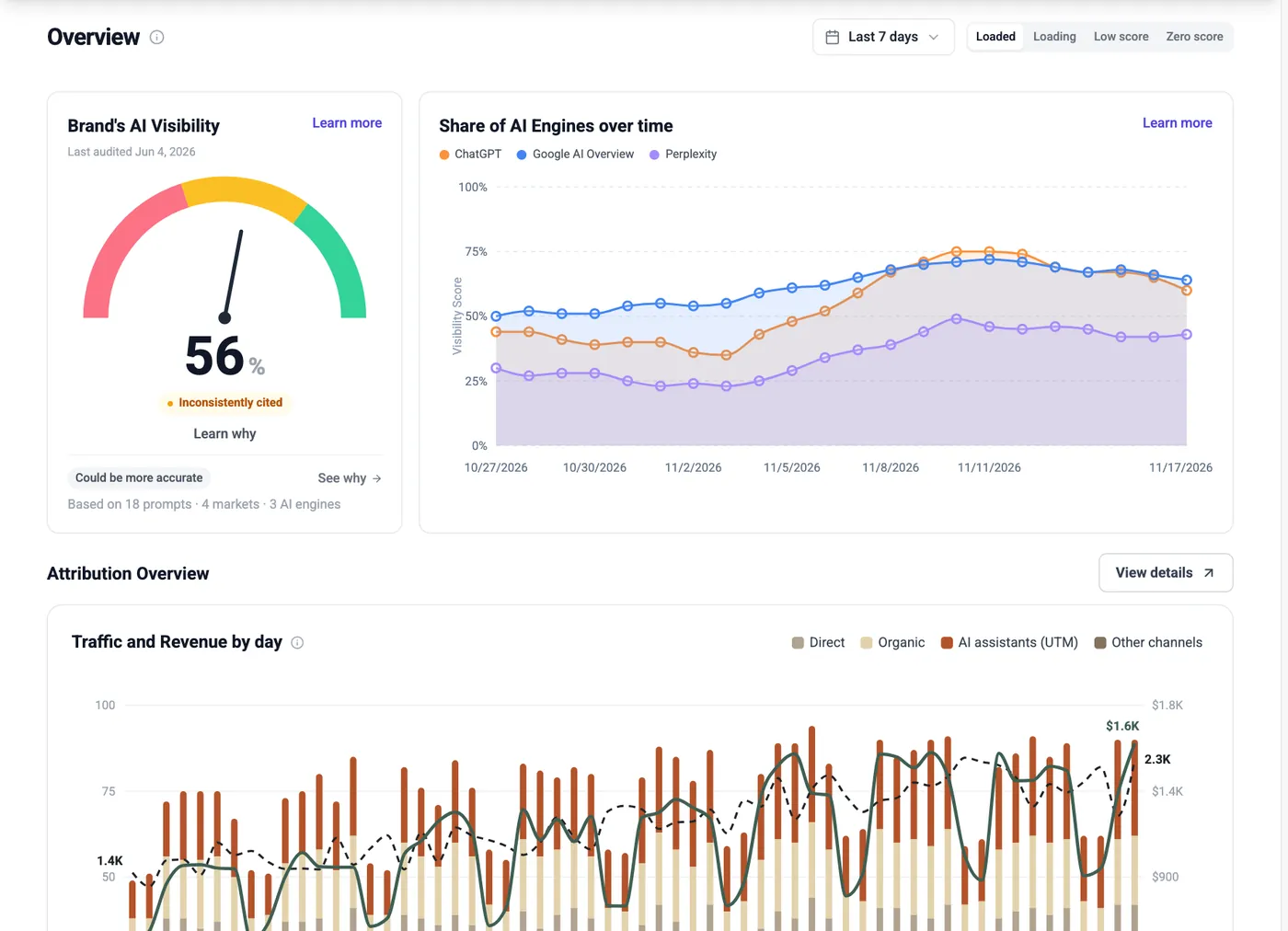
The Overview page puts the loop on one screen: your AI visibility score, visibility per engine over time and attribution of traffic and revenue. A good sign is the score and AI visits rising together. A warning sign is "inconsistently cited", which means your brand comes and goes between runs.
 123
- 1AI visibility score: 56%, inconsistently cited, from 18 prompts, 4 markets and 3 engines.
- 2Visibility per engine over time: ChatGPT, Google AI Overview and Perplexity.
- 3Attribution: traffic and revenue by day, with AI assistant visits.
Research for this lesson.
Our own studies behind this lesson. Each one has the key charts and numbers, and a link to the full article.
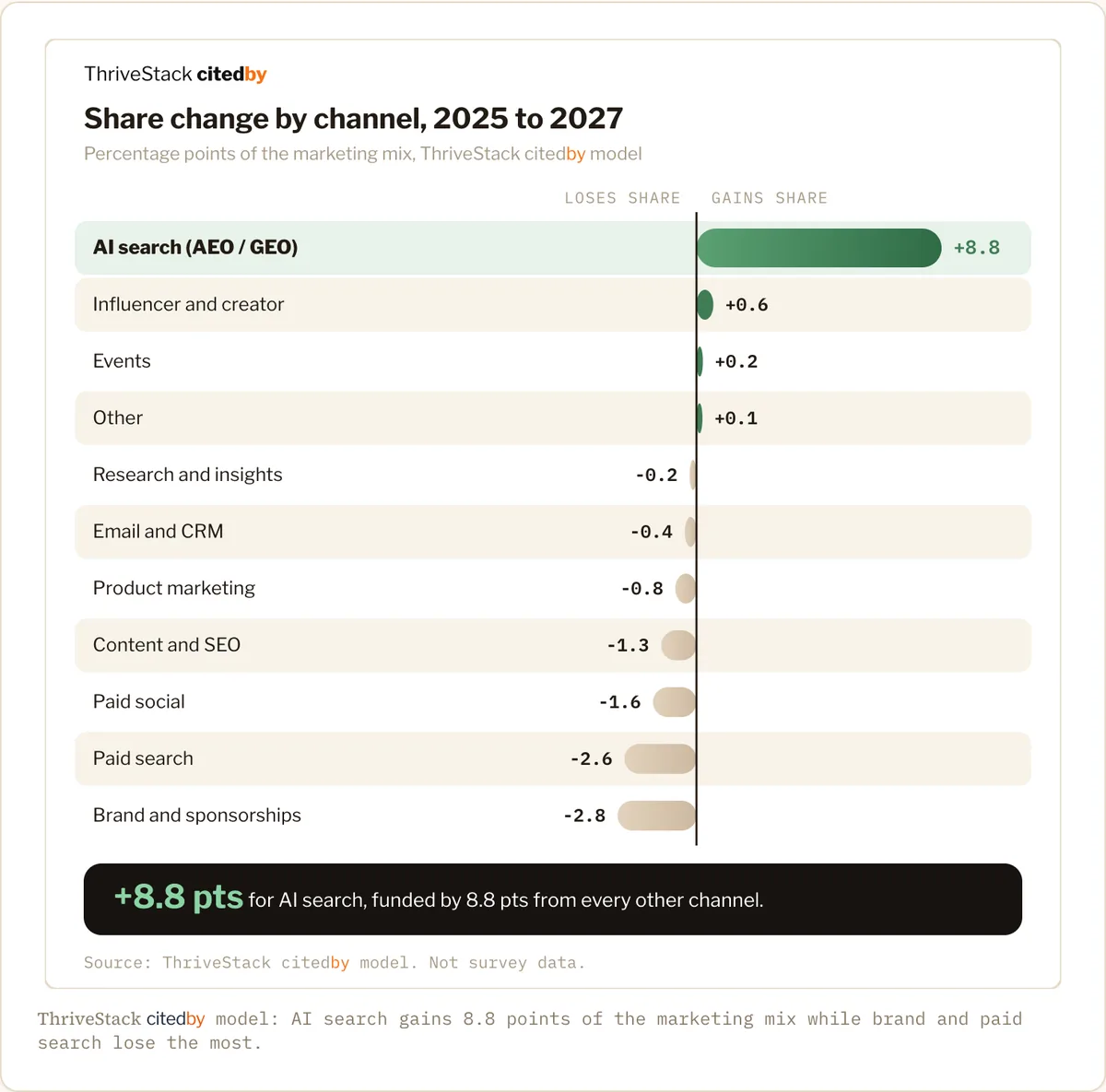
ThriveStack citedby runs every step of this loop in one place: prompt research, a tracked prompt panel across AI engines, a ranked action list, ChatGPT ads tracking and attribution to revenue.
The AI search optimization process, answered.
What is AI search optimization?
It is the work of getting your brand named and cited in AI answers from ChatGPT, Google AI Overviews and AI Mode, Perplexity, Claude and Gemini, and proving what those answers bring in.
How is it different from SEO?
SEO targets a ranked list of links. AI search targets the short answer an engine writes, which pulls from many searches and sources at once. Good SEO still helps, because engines read indexed pages.
How long does one loop take?
Plan on a month per loop: a week for research and baseline, two weeks for fixes and content, and a week to re-run the panel. Earned media and ads can take longer to show.
Do I need a tool?
You can do the research by hand. A tool saves the repeat work. ThriveStack citedby, our own product, runs the prompt panel, ranks the actions and joins crawls, citations and revenue.
All 10 questions this page answers.
These questions come from a query fan-out of "how to win AI search visibility". Each one has a short answer here, and the lesson above goes deeper.
What is AI search visibility?Informational
AI search visibility is how often AI answer engines such as ChatGPT, Google AI Mode, Perplexity, Gemini and Claude name, cite or recommend your brand when buyers ask about your category. You measure it as the share of tracked prompt runs that name you.
How to win AI search visibilityImplementation
Work a loop. Research the prompts buyers ask, let AI crawlers in, make your entity facts clear, fix the pages AI already reads, earn mentions on the sites engines cite, use ChatGPT ads where organic answers are out of reach, then tie visits to revenue. This course walks each step with one keyword.
How does AI search visibility work?Informational
An engine reads the prompt, often splits it into several searches, retrieves pages, then writes one answer and cites some of them. Google says AI Overviews and AI Mode may use this query fan-out. Your brand shows up when pages by you or about you are retrieved and trusted.
AI visibility vs SEOCommercial
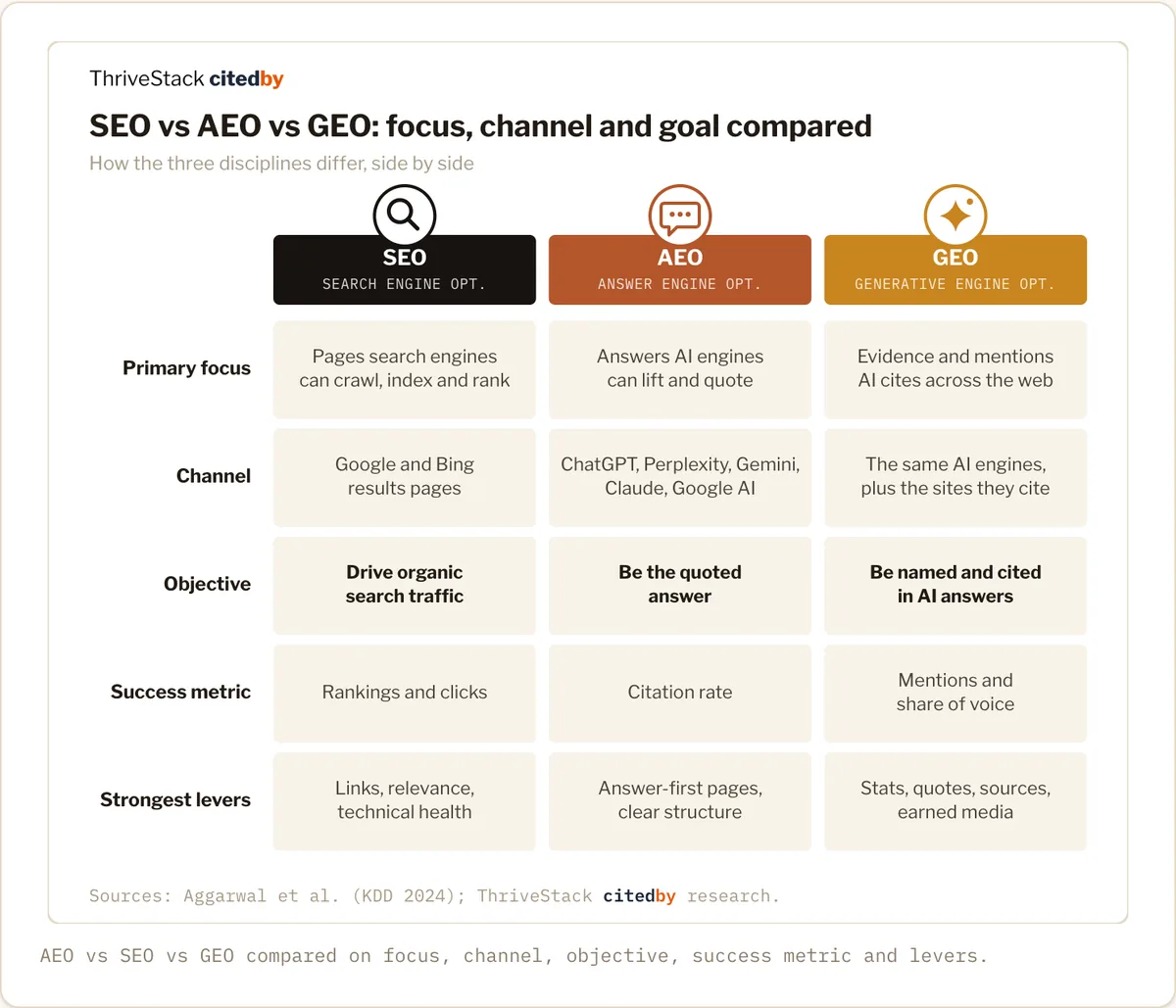
SEO ranks your pages in a list of results. AI visibility is about being named or cited inside one written answer. They overlap but are not the same: Ahrefs found only 37.9% of URLs cited in AI Overviews also ranked in the top 10 for that query (Mar 2026).
What is GEO optimization?Informational
GEO stands for generative engine optimization. The name comes from a Princeton-led research paper (KDD 2024) that tested ways to raise a source’s visibility in AI answers and reported gains of up to 40%. In practice it means the same work as AEO.
What is AEO optimization?Informational
AEO stands for answer engine optimization. It means shaping your pages and your presence on other sites so AI engines quote your answers and name your brand. It covers crawler access, quotable content, entity signals and earned mentions.
GEO vs AEO vs SEOCommercial
SEO ranks pages in search results. AEO gets your answers quoted by AI engines. GEO is the research name for that same AI work. AEO and GEO overlap almost fully, so most teams run two programs: SEO and AI visibility.
Why does AI search visibility matter?Troubleshooting
Buyers now ask AI for a shortlist and read one answer. Pew found people clicked a normal result on 8% of visits when an AI summary showed, against 15% without one (Jul 2025). If the answer does not name you, you can miss both the click and the shortlist.
How do AI engines recommend brands?Informational
Engines retrieve pages that answer the prompt, then name the brands those pages agree on and that fit the need. Mentions on other sites matter a lot: Ahrefs found branded web mentions had the strongest link to AI Overview brand visibility across 75,000 brands (May 2025).
AI search visibility strategy 2026Informational
Pick buying-intent prompts and track them across several engines. Fix crawl and entity basics first. Close citation gaps with owned pages and earned mentions, add ChatGPT ads where needed, and report to revenue. Judge visibility across many runs, because answers change run to run.
Sources for this lesson
- Google: AI Mode update, Elizabeth Reid (May 20, 2025) Fan-out and Deep Search
- Ahrefs: AI Overview citations and the top 10 (Mar 2, 2026) 863K SERPs, 4M URLs
- Pew Research Center: Google users click less with AI summaries (Jul 22, 2025)
- Muck Rack: Generative Pulse, earned media holds at 84% (May 8, 2026) Vendor claim, press release
- SparkToro: AIs are highly inconsistent when recommending brands (Jan 28, 2026) 2,961 runs
Figures were checked against each page on Nov 17, 2026. Vendor studies are labelled as vendor claims.