Track a prompt panel:
Set a baseline before you change anything
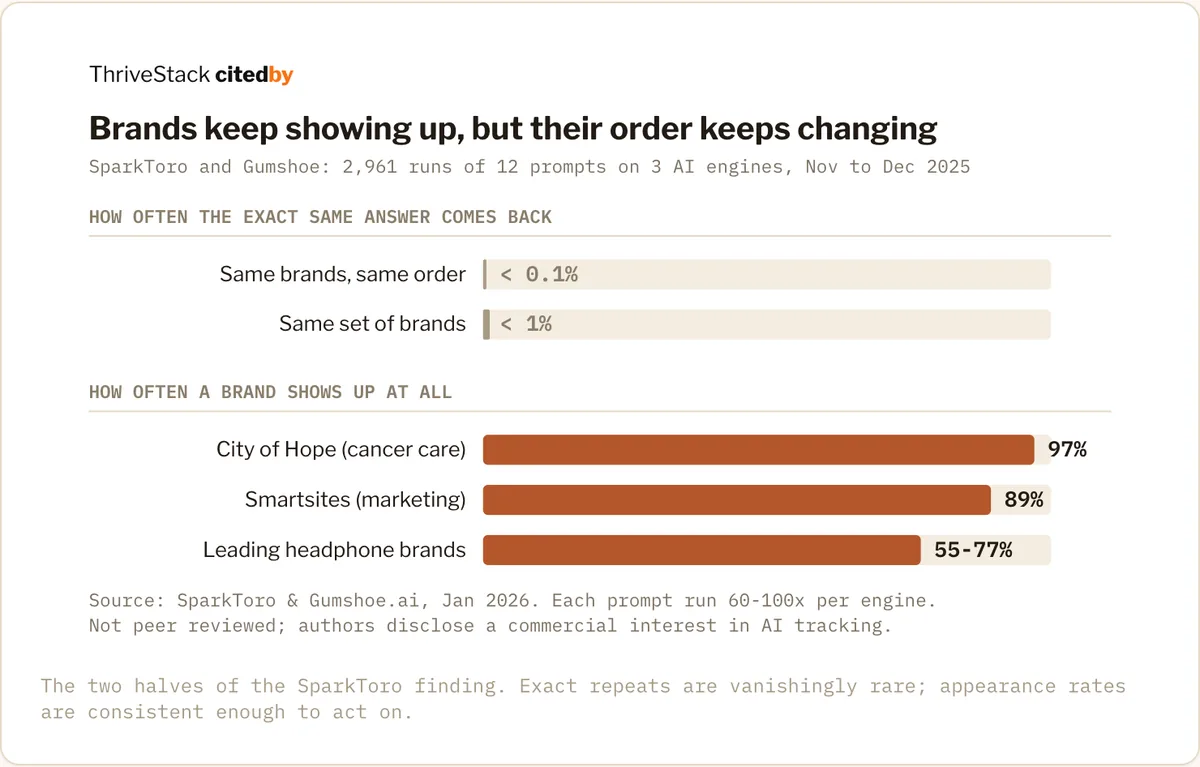
Track your prompts on a schedule across several AI engines, and measure visibility as the share of runs where you are named. One run proves little: SparkToro found the same brand list came back less than once in 100 runs. Record a baseline per prompt, topic and engine before you change pages.
chance ChatGPT or Google AI gives the same brand list twice
SparkToro, Jan 28, 2026chance the same list comes back in the same order
SparkToro, Jan 28, 2026prompt runs by about 600 volunteers in that study
SparkToro, Jan 28, 2026of 994 answers still named the top headphone brands
Search Engine Journal, Jan 30, 2026What should a prompt panel measure?
Measure visibility (how often you are named), position when named, and who else is named. Split each by engine and topic. Rand Fishkin suggests visibility across 60 to 100 runs as a fair metric, because single ranks swing.
share of runs where your brand is named
Main metricwhere you sit in the list when named
Secondarywhich brands each engine names instead
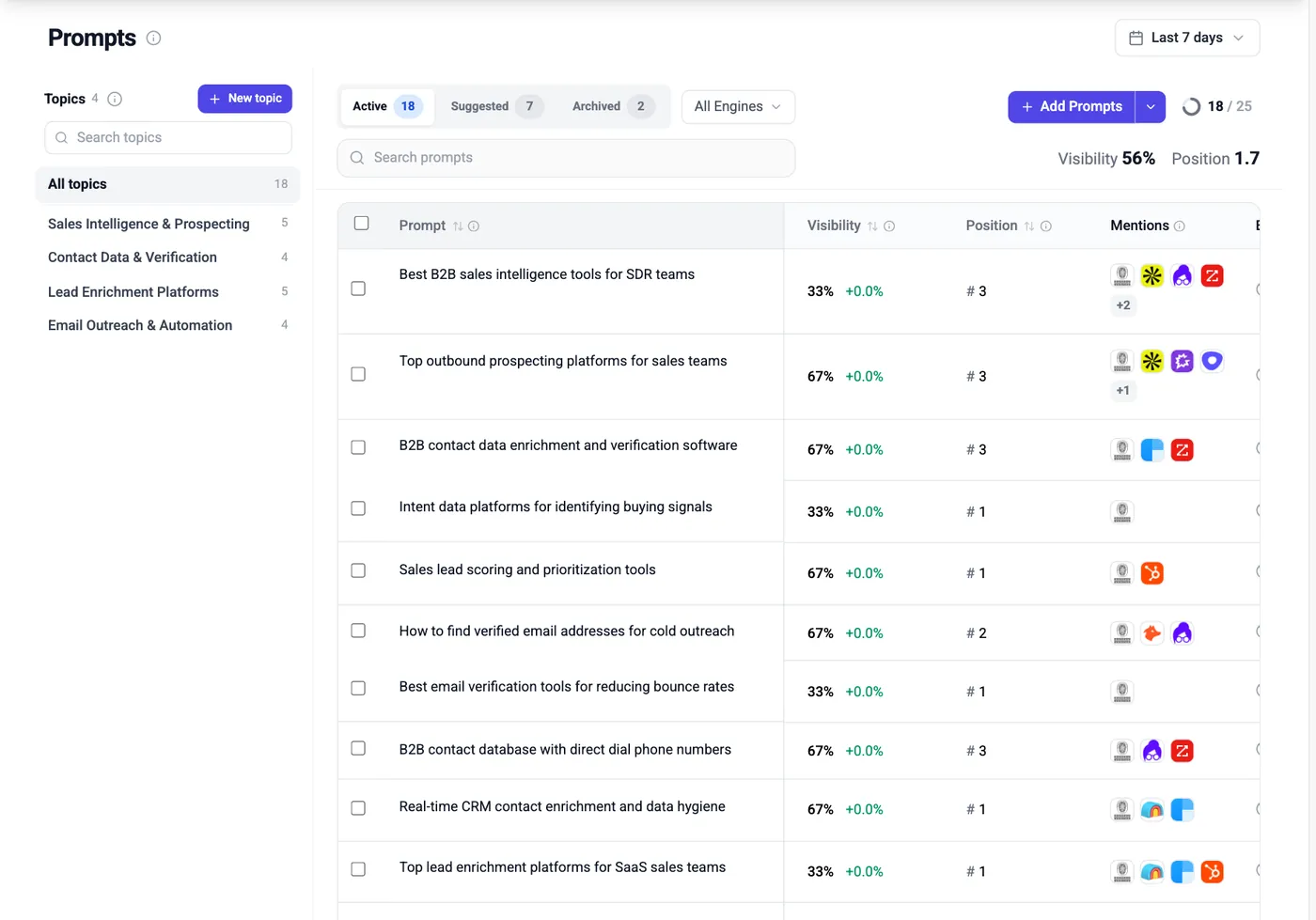
Competitive readHow do you read the Prompts page?
The Prompts page lists every tracked prompt with visibility, position and the brands each engine named. A good sign is visibility rising on unbranded "best X" prompts. A warning sign is high visibility only on branded prompts.
 1234
- 1Prompts grouped by topic, the clusters of your map.
- 2Active, Suggested and Archived prompts.
- 3Visibility: the share of runs where your brand is named.
- 4The brands each engine named, so you see who wins instead.
How long should you track before you act?
Track at least two to four weeks of runs before you call a change. Changes to tracked prompts apply from the next run, never to one already in progress.
- 20 or more unbranded prompts, grouped by topic
- At least three engines, such as ChatGPT, Google AI and Perplexity
- Weekly or daily runs for two to four weeks
- A saved baseline per prompt, topic and engine
Research for this lesson.
Our own studies behind this lesson. Each one has the key charts and numbers, and a link to the full article.
 Research · 5.3
AI visibility tracking research: Why the same prompt returns different brands
80unique completions from 1,000 identical prompts at temperature 0
Read the key findings →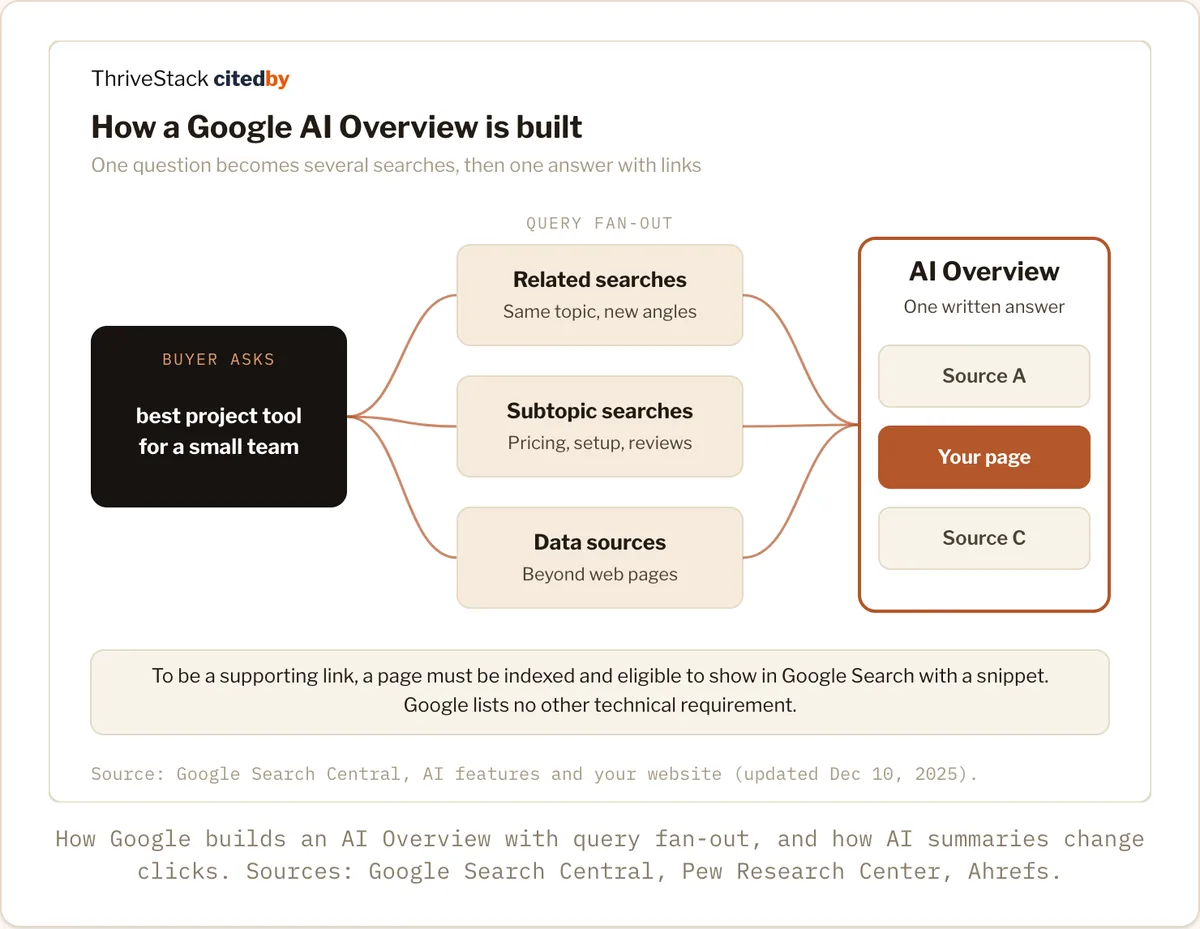 Research · 5.4
Google AI Overview tracker: How to see if Google cites your brand
58%lower click rate for the top result when an AI Overview shows (Ahrefs)
Read the key findings →ThriveStack citedby runs your prompt panel on a schedule across ChatGPT, Google AI, Perplexity, Claude, Gemini and more, and reports visibility, position and share of voice per prompt, topic and engine.
Track a prompt panel, answered.
Why not track my rank in ChatGPT?
Because the order changes almost every run. Visibility across many runs is steadier and easier to act on.
How often should prompts run?
Weekly is enough for most teams. Daily helps when you test changes and want faster reads.
Which engines should I track?
Start with the ones your buyers use: usually ChatGPT, Google AI Overviews and AI Mode, and Perplexity. Add Claude, Gemini and Copilot as you grow.
All 10 questions this page answers.
These questions come from a query fan-out of "how to win AI search visibility". Each one has a short answer here, and the lesson above goes deeper.
How to run GEO experimentsImplementation
Change one thing on a set of pages and leave a similar set alone as a control. Track the same prompts for both for 14 to 28 days, with seven or more runs per prompt, then compare.
AI visibility A/B testing methodologyInformational
Split pages or prompts into test and control, assign them at random where you can, measure visibility before and after, and use enough runs to rise above the noise.
How to test content changes in ChatGPTImplementation
Set a baseline on the target prompts, ship the change, wait for the page to be crawled again, then compare visibility over the same number of runs.
AI citation lift measurementInformational
Citation lift is the change in citation rate for the test group minus the change for the control group over the same period. Subtracting the control removes engine-wide shifts.
AI search visibility holdout testsInformational
Keep some pages or prompts untouched as a holdout, so you can tell your change apart from shifts that hit every brand at once.
How many prompts to track for GEOInformational
Start with a few dozen per topic area. Our prompt panel guide suggests 5 to 10 prompts per topic, for each persona, market and intent, with each prompt run several times a day per engine.
How to control AI answer variabilityImplementation
You cannot stop it, but you can average it out. Our research puts a single run’s standard error at 0.370, falling under 0.10 with seven runs per prompt.
How to measure GEO content impactImplementation
Compare visibility and citations for the target prompts before and after, against a control group, then follow through to AI visits and signups.
AI search optimization experiment templateInformational
Write down the hypothesis, pages changed, control pages, prompts, engines, runs per prompt, test window, metric and result. Our AEO experimentation roadmap lays out a 90-day plan.
How to prioritize GEO fixes by impactImplementation
Rank fixes by how many prompts they touch, the buying intent of those prompts and the effort needed. Do technical blockers first, since they unlock everything else.
Sources for this lesson
- SparkToro: AIs are highly inconsistent when recommending brands (Jan 28, 2026) 2,961 runs
- Search Engine Journal: AI recommendations change with nearly every query (Jan 30, 2026)
- ThriveStack docs: MCP tools reference Our own product docs
Figures were checked against each page on Nov 17, 2026. Vendor studies are labelled as vendor claims.