Original research for AI:
Publish data engines have to cite
Original research makes you the source for a number, so engines have to cite you for it. The GEO paper found adding statistics, quotations and cited sources raised visibility the most. Publish the method, put numbers in plain text and tables, and pitch the finding to the sites engines read.
visibility boost from GEO methods in AI answers
Aggarwal et al., KDD 2024higher impression score on Perplexity from adding statistics
Aggarwal et al., KDD 2024visibility gain from citing sources, for lower-ranked sites
Aggarwal et al., KDD 2024more citations when the same article ran on news sites
ThriveStack citedby researchWhy do engines cite original data?
An answer that states a number needs a source for it. If you published the number first, you are that source. The GEO paper tested this on 10,000 queries: statistics, quotations and cited sources helped most, and smaller sites gained the most.
add a number with its source
GEO paper, top methodadd an expert’s exact words
GEO paper, top methodlink each claim to its origin
+115.1% for lower-ranked sitesCan a small study be enough?
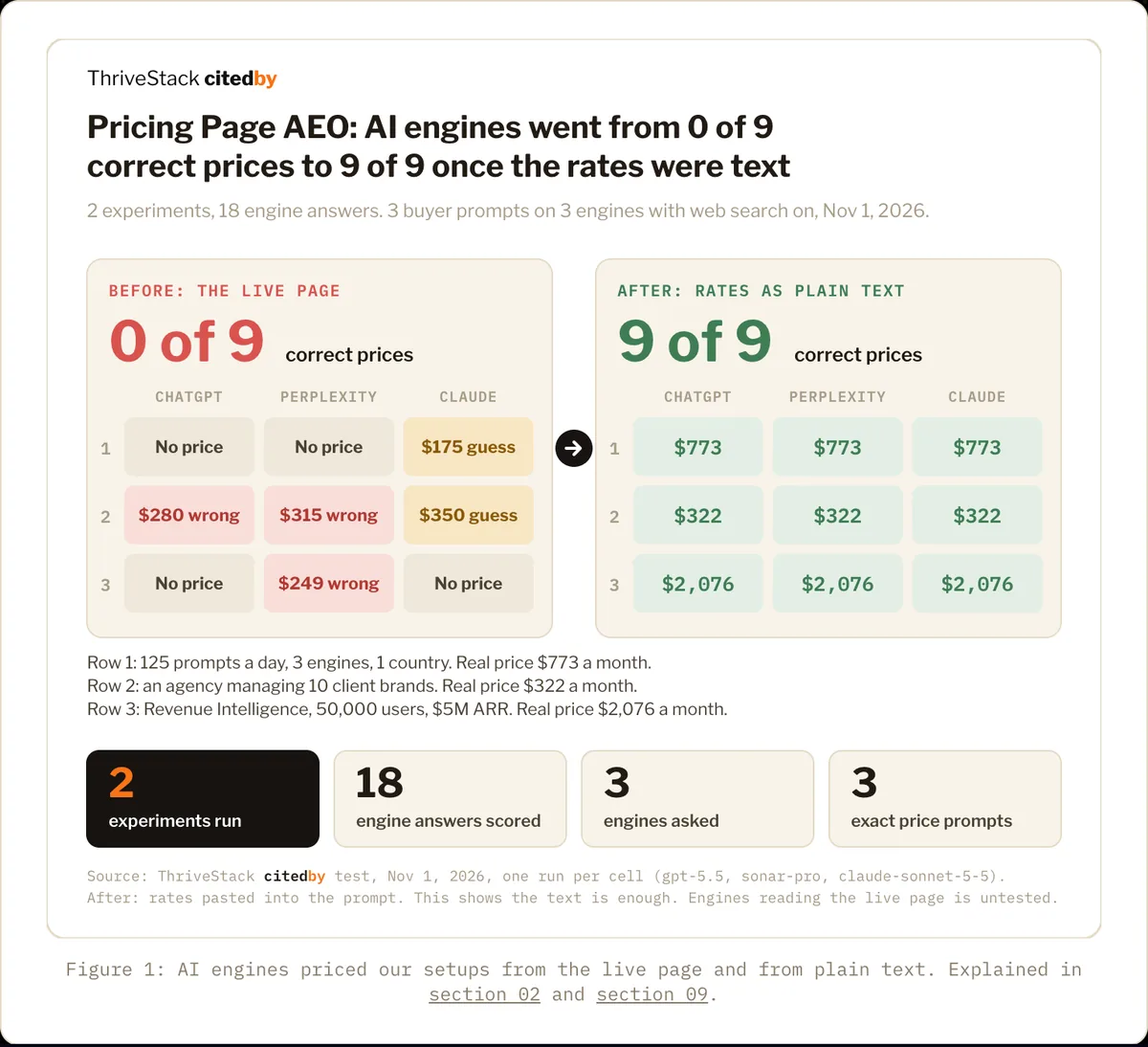
Yes. Our pricing page study scored 18 AI answers across two experiments, and it gave engines one clear finding to cite. Keep the method plain and the result easy to quote.
How do you build a study engines cite?
Pick a buyer question
Choose a question buyers ask AI where no good number exists yet.
Collect the data
Use a survey, your own product data or a test. Write down the sample and dates.
Publish one HTML page
Lead with the finding in one sentence, add the method, a chart and the data table in text.
Earn coverage
Pitch the finding to the sites engines cite for your prompts. Our research found 4x more citations when the same article ran on news sites.
Refresh yearly
Run it again each year and keep the same URL, so citations build up.
ThriveStack citedby shows which prompts lack a good source and which domains engines cite, so you know what to study and where to pitch it.
All 10 questions this page answers.
These questions come from a query fan-out of "how to win AI search visibility". Each one has a short answer here, and the lesson above goes deeper.
Does original research improve AI citations?Informational
It helps. The GEO paper found adding statistics raised visibility, by about 37% on Perplexity’s impression score. Engines need a source for every number, and original data makes you that source.
How to publish citable industry statisticsImplementation
Lead with the number in a sentence that stands on its own. Give the sample, method and date, put the data in an HTML table and keep the URL stable. Then pitch it to the sites engines already cite.
AI search visibility with proprietary dataInformational
Your own product or customer data gives facts no one else has, so engines have to cite you for them. Aggregate and anonymize it, explain how you collected it, and update it on a set schedule.
First-party research for GEOInformational
Run a survey, a test or a data pull, then publish the method and results on your own site. It can be small: our pricing page test scored 18 AI answers across two experiments and still gave engines a clear, citable finding.
How to make benchmark reports AI citableImplementation
Put one finding under each heading, keep numbers in text and not only in images, add a short summary at the top, a method section and a date, and give the report its own HTML page. Offer the chart and the data table together.
Primary sources vs secondary sources in AI searchCommercial
A primary source is where a fact first appears. A secondary source reports it. Engines cite both, and a clear secondary write-up often gets cited instead of a hard-to-read study. Make your primary page the easiest one to quote.
How to cite sources in GEO contentImplementation
Name the publisher and date in the sentence, link to the original page and label vendor claims. In the GEO paper, citing sources raised visibility by 115.1% for lower-ranked sources, so it helps smaller sites most.
Expert interviews for AI visibilityInformational
Quotes from named experts add facts and trust. The GEO paper found adding quotations was among the methods that helped most. Use their exact words, their name and role, and link to where they said it.
How to build original data studies for AEOImplementation
Pick a question buyers ask AI. Collect data through a survey, product data or a test. Write down the method. Publish the result as a page with a direct answer and a table, then earn coverage for it on cited sites.
Case studies that AI engines referenceInformational
Case studies with named customers, real numbers and dates give engines specific proof for "best for" prompts. Put the results in page text, not only in a PDF or an image.
Sources for this lesson
- Aggarwal et al.: GEO, Generative Engine Optimization (KDD 2024) Princeton and partners
- ThriveStack: AI trust signals engines reward Our own research
- ThriveStack: Pricing page AEO Our own research
Figures were checked against each page on Nov 17, 2026. Vendor studies are labelled as vendor claims.